




To set up a j5create docking station, first identify your dock's JCD model number and confirm your laptop supports DisplayPort Alt Mode for video and USB-C Power Delivery for charging. Then connect the dock's host cable to your laptop's USB-C or Thunderbolt port, attach the power adapter if your model supports it, and connect your monitors, peripherals, and network cables.
Before you set up your j5create docking station
j5create’s official pages document generic dock setup for USB-C docks, not a single universal “docking station” flow, so the exact steps and limits vary by model. Check your dock’s JCD model number, printed on the device, and verify your laptop supports DisplayPort Alternate Mode (for video output) and USB-C Power Delivery (for charging through the dock). Without these, video or power features may not work.
Connect the j5create dock to your computer
- Place the dock on a stable surface near your computer.
- Connect the dock’s host cable (or host cables, depending on the model) to an available USB-C or Thunderbolt port on your laptop.
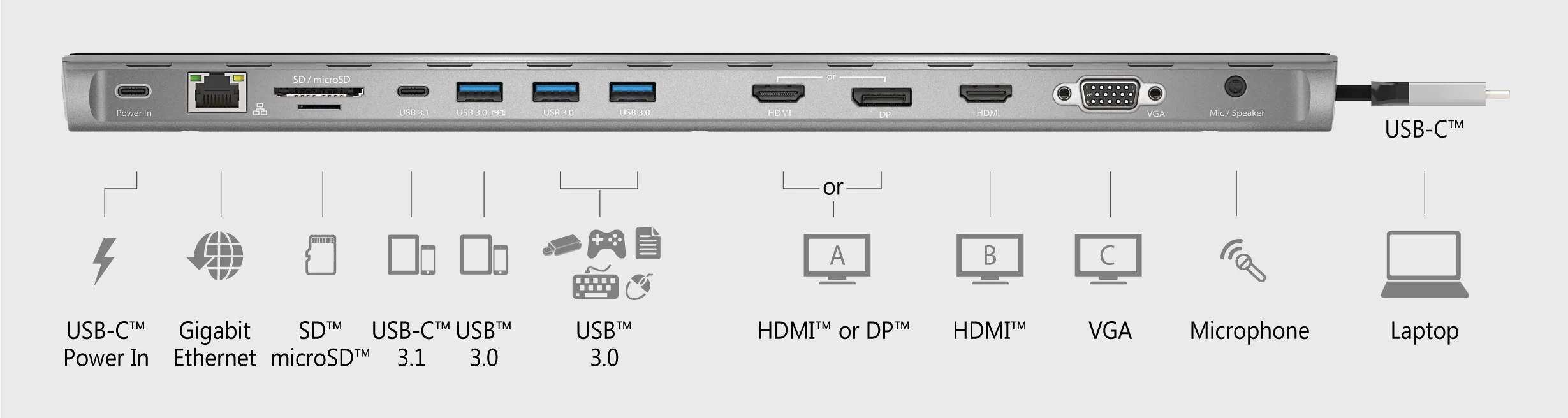
- If the dock supports charging, connect your laptop’s USB-C power adapter to the dock’s “USB-C Power In” or “Power In” port, then power on the dock.
Some models, like the JCD552, require a second USB-C host cable to be plugged into the 10 Gbps USB-C Gen 2 port to achieve optimal capability. After connecting, your computer should recognize the dock automatically on most Windows systems.
Attach monitors, peripherals, and network
- Connect external monitors to the dock’s HDMI or DisplayPort outputs using standard display cables.
- Plug USB peripherals such as a keyboard, mouse, or external drives into the dock’s USB ports.
- Connect an Ethernet cable to the RJ45 port if your model includes one.
- Insert SD or microSD cards only if the model has dedicated card slots.
This setup lets you turn a single USB-C connection into a full workstation with multiple displays, wired internet, and all your accessories. j5create docks are among the most versatile laptop docking stations for expanding connectivity.
Install drivers where required
Most Windows setups are plug-and-play with no driver installation needed. On Mac, driver installation is required for the JCD542 and for enabling dual extended displays on M1/M2/M3 MacBooks with the JCD3199. For the JCD3199, j5create documents that M1/M2/M3 MacBook users need a driver to enable dual extended display functionality. For all other models and configurations, no additional software is documented by j5create.
Adjust display settings in your operating system
For display output, adjust settings in your operating system to choose extended or mirrored mode. On Windows, go to Settings > System > Display and select your preferred multiple-display mode. On macOS, open System Settings > Displays and arrange or mirror your screens. j5create documents both Mirror and Extended modes for models like the JCD543 on Mac and Windows. The JCD543 supports Mirror and Extended modes on both Mac and Windows, but no additional on-device settings path is given.
Model-specific power delivery and port notes
Power delivery capabilities vary by model. The JCD552 and JCD533 support up to 100W Power Delivery pass-through. The JCD533 documentation says 'up to 100W' for Power Delivery, and includes HDMI, USB 3.0, Ethernet, SD, microSD, and audio jack ports. The JCD3199 recommends a 60W or higher USB-C power adapter for full functionality, with 140W PD 3.1 recommended for optimal performance. The JCD543 supports USB-C host connection and Power Delivery, though its official product page does not state a specific wattage limit. For the JCD552, remember that the second USB-C host cable must go to the 10 Gbps USB-C Gen 2 port to get optimal capability.
When to consult your dock's manual
Exact steps and limits depend on the JCD model. If displays aren’t detected or charging doesn’t work, locate the manual for your specific model number, printed on the dock itself, and follow its instructions. j5create’s official setup flow is consistent: connect the dock to the computer, attach power if needed, connect displays and peripherals, and install a driver only where the model’s Mac instructions require it.
Frequently Asked Questions
Can I use a j5create dock with an iPhone or Android phone?
Why won’t my external monitor display anything?
First, confirm your laptop supports DisplayPort Alternate Mode over USB-C. If it does, check that the display cable is fully inserted into both the dock and monitor, and that the monitor is set to the correct input source.
Do I need to install drivers on Windows?
No. Most j5create docking stations are plug-and-play on Windows. Driver installation is only documented for certain Mac models, specifically the JCD542 and the JCD3199 for M1/M2/M3 MacBooks.
How do I know which JCD model I have?
The model number is printed on the dock itself, usually near the ports or on the underside. Look for a label starting with “JCD” followed by four digits.
Can I charge my laptop through the dock?
Only if the dock supports Power Delivery and your laptop supports USB-C Power Delivery. Models like the JCD552 and JCD533 support up to 100W pass-through, while the JCD3199 recommends 60W or higher for full functionality.