




How to adjust gamepad speed with sensitivity curves
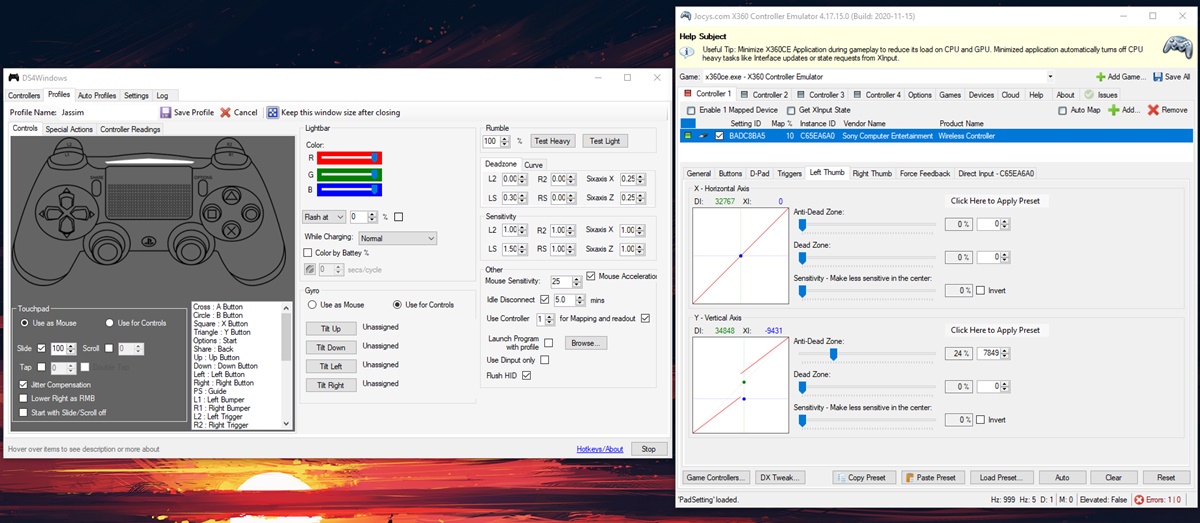
To adjust gamepad speed, you need to change how far you push the thumbstick versus how fast the in-game camera or character moves. This is done through sensitivity curves, which are built into premium controllers like the Xbox Elite Series 2 and the DualSense Edge, and can be customized through their official configuration apps. These curves let you choose between options like "Delayed," "Aggressive," "Instant," or "Smooth" responses, so you can make movements feel faster and more responsive or slower and more precise.
On the Xbox Elite Series 2, open the Xbox Accessories app on your console or PC. Select your controller profile, then go to the thumbstick settings. There, you'll find a sensitivity curve adjustment tool that lets you drag a graph to set the curve. You can choose from preset curves or create a custom one by dragging the curve's points. The "Delayed" curve makes the center of the stick less sensitive for precise aiming, while "Aggressive" ramps up speed quickly for fast turns. "Instant" gives you immediate response at the slightest push, and "Smooth" provides a gradual, linear feel.
Hardware modification methods offer another layer of control: adjusting thumbstick tension, modifying trigger sensitivity, swapping analog sticks, or adding weight can physically change how the controller feels and responds.
This is particularly useful for games where you want to make the right stick less twitchy for sniping or more reactive for close-quarters combat.
How to adjust gamepad speed in a game's settings
The most universal method to adjust gamepad speed is through a game's own settings menu. Most modern games include controller sensitivity sliders that let you change how fast the camera or character moves when you push the thumbstick.
Increasing the value makes the camera turn faster, while decreasing it slows things down for more precise aiming. Start with a mid-range value and adjust from there, if you're overshooting targets, lower the sensitivity; if you're turning too slowly, raise it.
Another key setting is the dead zone, which is the area around the thumbstick's center where no input is registered. If your character drifts or feels unresponsive, increasing the dead zone can help eliminate unintended inputs. Conversely, if you want more control at the edges of the stick, lowering the dead zone makes the gamepad more sensitive to small movements. These settings are typically located in the same menu as the sensitivity sliders.
How to calibrate your gamepad in Windows
If you're on a PC, Windows includes a built-in calibration utility that can reset your gamepad's default behavior and fix drift or unresponsive inputs. This is useful for gamepad setup and troubleshooting, especially when a controller feels off in multiple games. To access it, press Win + R to open the Run dialog, type joy.cpl, and hit Enter.
- Select your Xbox controller or generic gamepad from the list of connected devices.
- Click "Properties," then go to the "Settings" tab.
- Click "Calibrate" and follow the on-screen instructions. You'll be asked to move the thumbsticks in a circular motion and press the trigger buttons when prompted.
- When the calibration is complete, test the sticks and buttons to confirm everything responds correctly.
To reset the calibration to default settings, open joy.cpl again, select your controller, click "Properties," go to the "Settings" tab, and click "Reset to Default." This is a quick way to undo any problematic changes and return to the factory behavior. This built-in utility works for basic calibration of generic gamepads, not just Xbox controllers, so it's a reliable first step for any controller on Windows.
How to calibrate your gamepad in Steam
Steam offers its own controller calibration and configuration tools that work with a wide range of gamepads. This is particularly helpful if you use a non-Xbox controller or want to fine-tune joystick response beyond what a game offers. To calibrate your gamepad in Steam, follow these steps:
- Open the Steam client and go to the Steam menu in the top-left corner, then select "Settings."
- In the left pane, switch to the "Controller" tab under "General Settings."
- Select your controller from the "Detected Controllers" list.
- Click the "Calibrate" button and follow the on-screen instructions.
- When prompted, click "Start Full Autocalibration" and move the analog sticks in all directions as directed.
Steam's calibration also lets you adjust the joystick response curve for each stick independently. You can set a "Precise" curve for small, controlled movements or a "Wide" curve for faster, larger inputs. This is separate from in-game sensitivity settings, so it applies globally across all games launched through Steam. If you play a game that doesn't have its own sensitivity options, this is the best way to adjust gamepad speed.
Customizing button mapping for better control
Remapping buttons can complement speed adjustments by making your control scheme feel more intuitive, which indirectly improves your reaction time. If you find yourself fumbling for a button or having to move your thumb too far, remapping can place critical actions closer to your fingers. This is especially useful for games that require fast reflexes, like shooters or fighting games, where a well-mapped layout can make your inputs feel snappier.
On the Xbox Elite Series 2, you can remap the paddles on the back of the controller to any button, so you never have to take your thumbs off the sticks. The DualSense Edge also offers back buttons and remappable functions through the PlayStation system settings. On PC, Steam's controller configuration tool allows you to remap any button, trigger, or stick input, and you can save different profiles for different games. Third-party software like JoyToKey and Xpadder offer gamepad customization beyond Steam, letting you map keyboard and mouse inputs to your controller for games that lack native support. By combining remapped buttons with adjusted sensitivity, you create a control scheme that feels both fast and precise, reducing the gap between your intent and the on-screen action.
Frequently Asked Questions
How do I adjust the gamepad speed?
Open your platform's settings menu: on Xbox, go to the Xbox Accessories app; on PlayStation, go to Settings > Accessories > DualSense Edge Wireless Controller; on PC, use Steam's Controller settings or the Windows calibration tool via joy.cpl. From there, select your controller profile and navigate to the thumbstick or sensitivity options to adjust curves and sliders.
Can I adjust gamepad speed on all gaming platforms?
Most modern platforms, including PlayStation, Xbox, and PC, offer some way to adjust gamepad speed, but the options vary. Console games often have sensitivity sliders, while premium controllers like the DualSense Edge and Xbox Elite Series 2 add system-level curves. Older consoles or certain games may not include these options, so your mileage may vary.
Will adjusting gamepad speed improve my gaming performance?
Yes, if you're struggling with accuracy or responsiveness, adjusting speed can help. Lower sensitivity gives you more control for precise aiming, while higher sensitivity lets you turn faster. It may take some trial and error to find the right balance, so test different settings in-game and adjust gradually.
Can I adjust gamepad speed for specific games?
Yes, many games have their own controller sensitivity settings that override the system defaults. This lets you set a slower speed for a stealth game and a faster one for a shooter. Some games also offer presets or separate sliders for aiming down sights versus general look sensitivity.
What is a dead zone and why does it matter?
The dead zone is the small area around the thumbstick's center where movement is ignored. A larger dead zone prevents stick drift but makes small adjustments harder, while a smaller dead zone increases precision but can cause unintended movement. Adjusting it alongside sensitivity is key to getting the right feel.
Do third-party tools work for adjusting gamepad speed?
Yes, third-party software like Steam's controller configurator or specialized programs can offer more granular control than in-game settings. These tools often let you adjust sensitivity curves, dead zones, and button mapping globally. Always download from reputable sources to avoid compatibility or security issues.
Are there any third-party tools or software to adjust gamepad speed?
Yes, tools like JoyToKey, Xpadder, and reWASD allow you to adjust dead zones and customize sensitivity curves beyond what official software offers. These programs let you fine-tune stick response and create custom profiles for individual games, providing more precise control over gamepad speed.