




Your phone shows one bar, then none. Calls drop mid-sentence. Texts sit unsent in a queue. That hollow signal icon is one of the more unsettling things a smartphone can show you, especially when you need to reach someone fast. Most people immediately start poking at settings, yanking the SIM card, and restarting apps at random. That approach rarely helps. There is a smarter order to do things, and it starts with figuring out whether the problem lives in your pocket or out in the network.
Signal Diagnostic: Three Things to Know
- Always rule out a carrier-wide outage before touching any phone settings.
- A simple airplane mode toggle and full restart clears the majority of temporary signal drops.
- If the carrier checks out fine, resetting network settings on your device is the most reliable next fix.
The Two-Second Fix That Works More Often Than It Should
Start with the basics before assuming anything is seriously wrong. Toggle airplane mode on, wait five full seconds, then toggle it back off. This forces your phone to drop its current connection and reach out to a nearby cell tower from scratch. Think of it as telling your phone to introduce itself to the network all over again. If your signal returns within a minute, the problem was temporary and the reconnect sorted it out.
If that does not help, do a full restart. Not sleep mode. Not a screen lock. A complete power-off and power-on cycle. This clears the phone's radio stack, which handles all communication with cell towers, and gives it a clean start. A surprising number of signal problems trace back to the radio software getting stuck in a bad state after a software update, a dropped call, or a long stretch in a low-signal area.
Try changing your location as well. Walk outside if you are indoors, or move away from thick concrete walls. Buildings with dense materials, basement levels, and certain elevator shafts are notorious for swallowing signals that are perfectly healthy just ten feet away. If your signal reappears when you step outside, the structure itself is absorbing the signal. That is not a carrier problem. It is not a phone problem either. It is physics.
What a Faulty or Displaced SIM Card Actually Looks Like
If the basics did not restore service, the SIM card deserves a closer look. The SIM is a small chip that registers your phone's identity on the carrier's network. If it sits slightly off-center, has picked up debris, or got damaged, your phone cannot authenticate itself, and no amount of settings changes will fix that underlying failure.
Power the phone off completely before touching the SIM tray. Remove the card, inspect it for visible scratches or grime, and reseat it firmly before restarting. A SIM can shift slightly during a drop or when a phone overheats. A loose card that looks fine can still cause intermittent dropouts that mimic a carrier outage perfectly.
Watch for these signs that the SIM may be the source of your trouble:
- Your phone shows "No SIM" or "SIM not recognized" in the status bar or notification tray
- Service cuts out in random bursts, even in spots where you normally have strong, consistent bars
- You have full Wi-Fi connectivity but zero cellular data and cannot make or receive calls
- The problem appeared right after a physical drop or a period of unusual heat exposure
- A different phone running the same SIM card shows the exact same service loss
That last point matters a lot. If you can swap your SIM into a friend's phone and the no-service problem follows the card to the new device, you have found the culprit. If the other phone picks up signal fine with your SIM, the card is healthy and the issue is somewhere in your own device.
Rule Out a Network-Wide Problem Before Resetting Anything
Here is where a lot of people waste genuine time. They spend an hour cycling through network resets, reinstalling apps, and even factory resetting their device, only to discover that their carrier's tower went down hours ago and the whole neighborhood is affected. Before you reset anything, confirm there isn't a carrier outage? affecting your area.
Check on a second device, ideally a laptop or tablet on Wi-Fi. Look up your carrier's name alongside the word "outage" in a search engine. Most major carriers also post service alerts on their official social media accounts, and their support websites often include interactive outage maps you can filter by city or zip code.
You can also call your carrier's support line from a landline or a borrowed phone. Many carriers run automated systems that play a recorded message during known outages so their support staff are not buried under identical calls. If that message plays for you, you have your answer. The fix is waiting, not tinkering.
Ask a neighbor or coworker on the same carrier whether they are having trouble. If several people on the same network in the same part of town are all getting no service, the carrier is the common thread. If everyone around you is fine and you are the only one affected, the problem is isolated to your account or your device specifically.
Reading the Symptoms: What Each Signal Pattern Points Toward
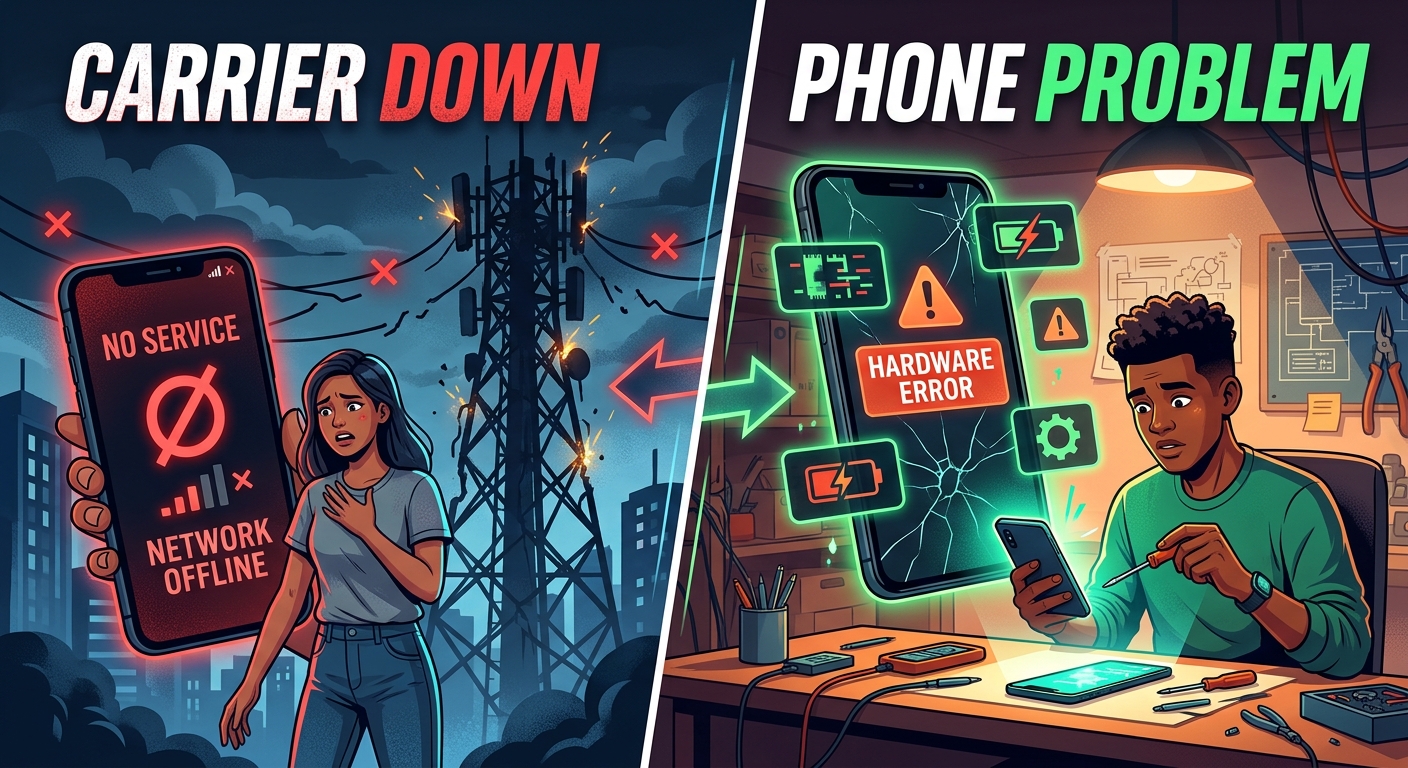
The specific symptoms on your screen can tell you quite a bit about where the failure originates. Some patterns strongly suggest carrier-side failures. Others almost always trace back to the device itself.
Carrier Issue or Phone Issue? A Symptom Guide
| Symptom | Points to Carrier | Points to Your Phone |
|---|---|---|
| Complete signal loss in a normally strong area | Yes, especially if multiple people on your carrier are affected | Possible if only your device is impacted |
| No cellular signal but Wi-Fi calling still works | Likely a tower or coverage gap issue | Less likely |
| "SIM not recognized" error message on screen | No | Yes, SIM card or device hardware |
| Problem started immediately after a software update | No | Yes, carrier settings profile likely needs refreshing |
| Issue persists after a complete power cycle | Yes, if an active outage is ongoing | Yes, points to a deeper device or account issue |
| Another phone on the same carrier has full signal | No | Yes, very strongly indicates a device problem |
Device-Side Fixes Once the Carrier Is Cleared
You have confirmed the carrier is operating normally, other people on the same network have signal, and your SIM looks fine. Now it is time to work through the device-level fixes in order, starting with the least invasive option and moving up from there.
Reset Network Settings on Your Phone
Resetting network settings wipes stored Wi-Fi passwords, Bluetooth pairings, and cellular configuration files back to their factory defaults. It does not delete photos, apps, or personal data. On an iPhone, this lives under Settings, then General, then Transfer or Reset iPhone, then Reset, then Reset Network Settings. On Android, the path varies by manufacturer but typically runs through Settings, then System or General Management, then Reset, then Reset Network Settings.
After the reset, your phone restarts and attempts to connect to your carrier fresh. This clears out a lot of issues that accumulate quietly over time, including corrupted APN settings, outdated carrier profiles, and misconfigured roaming preferences left behind by a previous trip or software update.
Update Your Carrier Settings Profile
Carriers push small configuration updates to phones separately from full iOS or Android system updates. These carrier settings files adjust how your phone connects to specific towers, handles handoffs between bands, and manages data routing. On an iPhone, go to Settings, then General, then About. If a carrier settings update is waiting, a prompt appears automatically within a few seconds. Install it and restart. According to the FCC's wireless consumer resources, carriers regularly update network configurations, and devices running outdated profiles can lose compatibility with newer network infrastructure.
On Android, carrier settings updates are typically bundled with system software updates. Go to Settings, then About Phone, then Software Update, and install anything pending. A phone running months-old software on a carrier that has upgraded its network can end up miscommunicating with the towers around it.
When Nothing Works and the Carrier Is Confirmed Fine
If every step above has produced no result and the carrier is definitely operational, there are a few remaining possibilities worth checking before heading to a repair shop.
- Your account may have a billing issue that suspended service, even if you do not recall a missed payment or billing dispute
- Your device's cellular antenna or modem hardware may be physically damaged from a drop, a bend, or liquid exposure
- Your phone may have been flagged or blacklisted due to a failed device payment plan or a reported theft
- Your number may have been fraudulently ported to a different device, a type of account takeover sometimes called SIM swapping
A call to your carrier's customer service line from any working phone will surface any account-level flags within minutes. If the account is clean and the hardware looks physically intact, a local repair shop can test the cellular modem and antenna directly. Most can run that diagnostic in under an hour and tell you whether the internal radio components are functioning.
Your Shortest Path from Confusion to Certainty
Losing cell service does not have to be a guessing game. Work through the sequence in order and you will have your answer far faster than random troubleshooting allows. Start with the simplest physical and software checks. Rule out a carrier-wide problem before assuming your device is broken. Test whether the issue is exclusive to your device by checking with a neighbor or swapping SIMs. Then step through the device-side fixes from least to most disruptive.
The logic holds up every time. If other people on your carrier have full signal and you do not, the problem belongs to your device or your account. If nobody on your carrier has signal in your area, patience is the only tool that will fix it. Either way, you will know precisely what you are dealing with, and that is what keeps you from spending an afternoon resetting a perfectly healthy phone while a tower quietly comes back online down the street.