



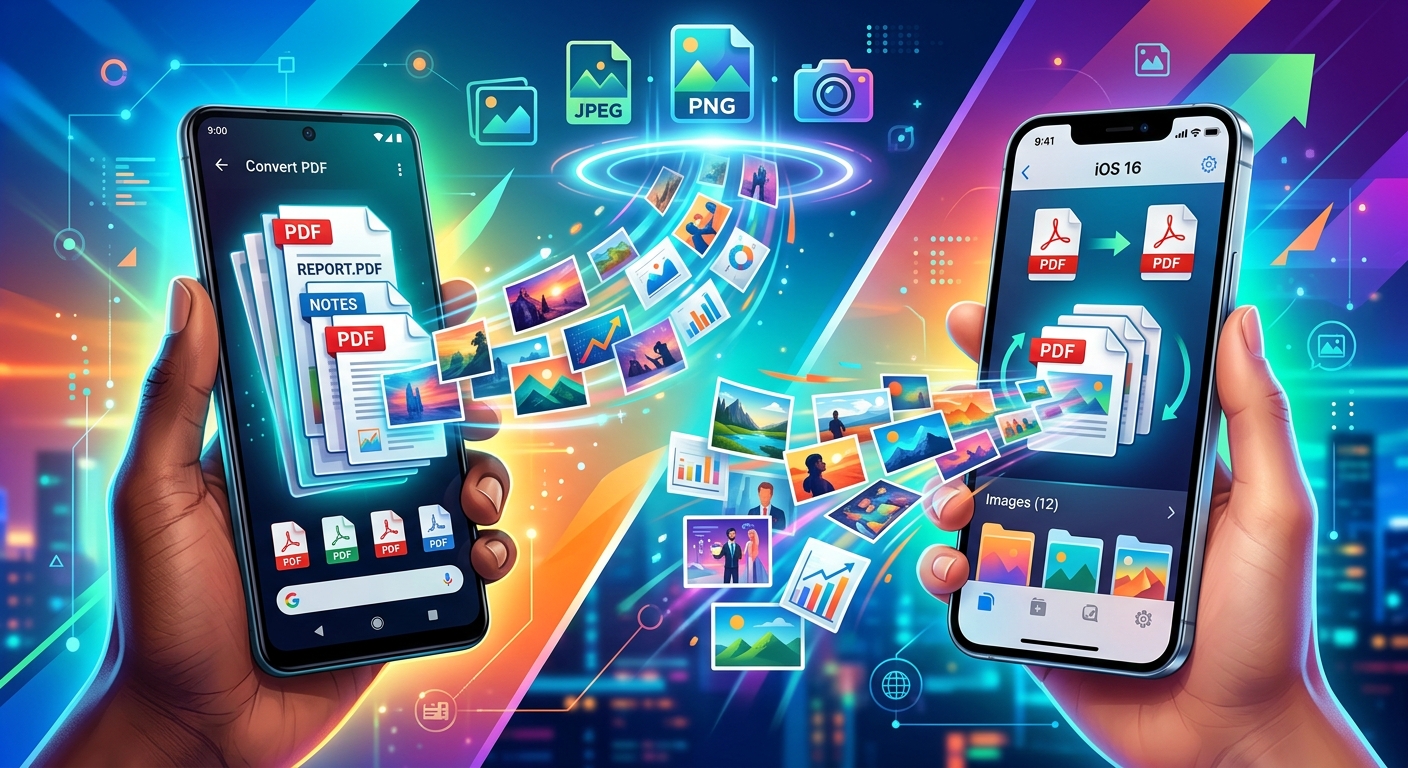
You get a PDF. You need to post it, share it, or attach it somewhere that only accepts images. The file just sits there, unopenable in the context you need, while you try to figure out your next move. This is a surprisingly common frustration for smartphone users, and the fix is easier than most people expect.
Your PDF can become an image in under a minute, straight from your phone.
- Screenshots work for single-page PDFs but reduce quality on detail-heavy or multi-page documents.
- iOS and Android both include built-in options that handle basic PDF-to-image conversion without third-party apps.
- Browser-based converters deliver clean, full-resolution results on any smartphone, with no installation required.
The Situations Where This Actually Comes Up
You want to post a contract snippet to a group chat. The online form you are filling out only accepts PNG or JPG uploads. A colleague sent you a PDF brochure and you want to share a single page to your Instagram story. The messaging app you are using will not render PDF previews, and the recipient sees nothing but a blank attachment.
These are all real, everyday scenarios. In each case, what you need is an image file, not a PDF. The good news is that your phone can handle this, usually in under a minute, without any special software.
Starting with Screenshots on Your Phone
The screenshot method is the most obvious starting point. It works fine for simple, single-page documents where you do not need pixel-perfect output.
On iPhone, open the PDF in the Files app or in Mail, then press the Side button and the Volume Up button at the same time. The screenshot saves to your Photos app as a JPEG. If you have an older model with a Home button, press the Home button and the Power button together instead.
On Android, open the PDF in Google Drive or your default PDF viewer. Then press the Power button and the Volume Down button simultaneously. The image saves directly to your gallery app.
The catch with screenshots is quality. If the PDF has small text, detailed graphics, or dense formatting, the screenshot will look sharp on your phone screen but may appear blurry when shared at full size or printed. Screenshots also only capture what is visible on your screen at that exact moment, which means a five-page PDF requires five separate screenshots taken one at a time.
Getting a Cleaner Result on iPhone
Apple's built-in tools go further than basic screenshots. If you open a PDF in the Files app, press and hold the file icon, then tap Share and choose Save to Photos. On many iOS versions, this saves the first page as a PNG image directly to your camera roll, at a resolution much closer to the original document than a screenshot would give you.
The Shortcuts app on iPhone is another path. You can build a simple automation that takes a PDF and converts individual pages to images. It is not the most beginner-friendly approach, but it is free and does not require any third-party tools. Apple's Shortcuts library includes actions for splitting PDFs and exporting pages, which makes the process workable once you understand the basic flow.
What Google Drive Does on Android
On Android, Google Drive offers a roundabout but reliable approach. Open the PDF in Google Drive, tap the three-dot menu in the top corner, and choose Print. From the print dialog, tap the dropdown at the top and look at your destination options. The print preview renders the PDF cleanly and at a good resolution, and you can take a screenshot of that preview to capture a well-formatted, full-width version of the page.
It is a slightly indirect workaround, but the output looks noticeably better than screenshotting the PDF directly from a standard viewer app. The print preview strips out any app interface elements and gives you a clean, white-background rendering of the document.
When Built-In Methods Are Not Enough
Screenshots and native sharing options have real limits. They work one page at a time. They do not always preserve the full resolution of the original file. And if you are dealing with a multi-page document that needs to be converted page by page, doing it manually becomes tedious fast.
This is the point where a browser-based conversion tool earns its place. You do not need to install anything. You do not need to create an account. You just need your phone's browser and a few seconds.
Using a Browser-Based Tool for Full-Page Conversion
Open your phone's browser, whether that is Safari, Chrome, or anything else you prefer, and head to a conversion tool that runs entirely in the browser. These tools are designed to work on mobile screens, and most handle the upload and download process smoothly even on smaller displays.
For clean PDF to JPG conversion, a browser-based option lets you upload a file directly from your phone's storage and receive JPEG images in return, one for each page. The process is simple: tap to upload, wait a few seconds while the tool processes the file, then download the results. No account is needed, and no app needs to be installed first.
This approach is especially useful for multi-page documents. Instead of taking ten screenshots of a ten-page PDF, you upload once and download ten clean image files. The output quality is also significantly better than a screenshot because the tool renders the PDF at a high resolution before the conversion happens, rather than just capturing whatever pixels happen to be on your screen.
Tips for Getting the Most Out of Your Converted Images
Once you have your image files ready, a few simple habits will save you trouble when sharing or uploading them.
- Check the file size before sending. High-resolution conversions can produce large files. If the platform you are sharing through has a size limit, compress the image first using your phone's built-in editing tools or a free compression option in your browser.
- Rename your files if you are sending multiple pages. A clear naming pattern like "proposal-page1.jpg" is far easier to manage than a long string of random characters generated by a converter tool.
- Crop out white margins before posting to social media. PDF pages almost always have padding around the content, and that padding wastes valuable space in a square or portrait frame on Instagram, X, or Facebook.
- Check the required format before converting. Some platforms accept JPG but not PNG, or the reverse. Most conversion tools let you choose the output format before downloading, so it is worth confirming your requirements before you start.
Understanding Why PDFs Are Not Already Images
If you have ever wondered why this extra step is needed at all, the answer lies in what the format was originally built to do. Portable Document Format was designed to preserve the layout and appearance of a document regardless of which device or operating system opens it. It is a container that holds text, fonts, vector graphics, and structural metadata in a specific, structured way.
An image, by contrast, is just a grid of colored pixels. There is no concept of a "font" or a "column" or a "margin" inside a JPG file. That fundamental difference in how the two formats work is why a conversion step is needed, and why the quality of that conversion matters depending on what you plan to do with the result.
For a casual group chat message, a screenshot is usually more than good enough. For a business document, a customer form, or anything that needs to look professional, the extra step of using a proper converter is worth the effort.
Choosing the Right Method for Your Situation
Not every situation calls for the same approach, and understanding the tradeoffs helps you pick the fastest path without overcomplicating things.
If you only need one page and the quality does not need to be perfect, a screenshot is genuinely the fastest option. Two button presses and you are done. For most chat messages or informal shares, this is more than adequate.
If you are on iPhone and the file is already in the Files app, the Share to Photos option saves you from opening a browser at all. It is built in, reliable, and produces a better result than a raw screenshot in most cases.
If you are on Android and already have the PDF open in Google Drive, the print preview trick delivers a cleaner image than a standard screenshot without requiring any extra tools. It takes an additional step or two, but it costs nothing.
If quality matters or you have more than one page to convert, a browser-based tool is the right call. The difference in output is visible side by side, and the extra minute required to upload and download is worth it when the final image needs to look polished.
From One Format to Another, Right From Your Pocket
Converting a PDF to an image used to feel like a task that demanded a desktop computer. It does not anymore. Between the native features built into iOS and Android and the conversion tools that run directly in your mobile browser, you can go from a PDF file to a shareable image in minutes, with no downloads, no subscriptions, and no extra hardware.
The methods covered here span a range of effort and output quality, which means there is a workable option regardless of how much the situation demands. A quick share in a group chat calls for a different approach than sending a clean, professional document image to a client or uploading to a form that requires a specific image format.
Once you know which method fits which situation, the process stops feeling like a workaround and starts feeling like just another thing your phone does without a fuss.