


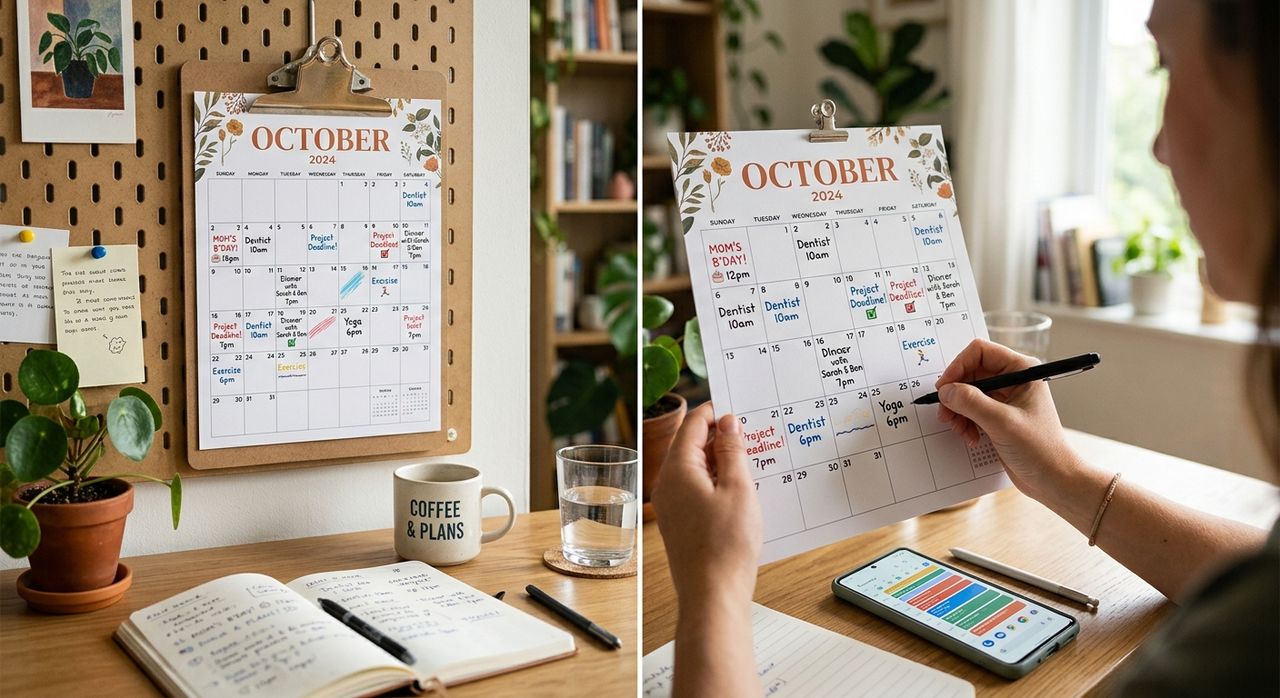
Your phone has Google Calendar, Apple Calendar, Fantastical, Notion, and probably three other scheduling apps you downloaded and forgot about. And yet, every January, people are still printing out paper calendars and sticking them to the fridge. That is not nostalgia. That is something more interesting.
Key Takeaways:
- Paper calendars remove the distraction layer that comes with opening a scheduling app on your phone
- Handwriting information onto paper strengthens memory encoding in ways that typing does not
- Hybrid planning, using both digital and paper formats, is increasingly the preferred approach for productive people
- The week-at-a-glance format pairs most cleanly with a digital calendar rather than competing with it
- Printing a planner costs almost nothing and removes the friction of an app subscription or a complex interface
The Paradox of Planning on a Device Built for Distraction
Smartphones are extraordinary tools. In your pocket, you carry a camera, a bank, a library, a map, and a communication hub. The problem is that all those functions live in the same place as your calendar app.
You open your phone to check Tuesday's meeting. Before you get there, a notification slides down from Instagram. Then a text. Then you notice your battery is at 11% and suddenly you are looking for a charger instead of checking your schedule.
This is not a personal failing. It is architecture. The phone is optimized for engagement, not focus. Every app is competing for your attention the moment you unlock your screen.
A printed calendar does not do that. It shows you the week. That is all it shows you.
What Cognitive Science Tells Us About Paper and the Brain
There is actual science behind why writing things down on paper tends to stick better than typing them. The act of physically writing engages motor memory alongside visual processing, which creates a richer memory trace.
Researchers studying cognitive load, the mental effort required to process information, consistently find that reducing extraneous demands helps people retain and act on what they have planned. A phone screen with multiple active notifications adds to that load. A piece of paper with only your schedule on it does not.
This is why students who take handwritten notes tend to retain material better than those who type. The same principle applies to planning your week.
Paper Did Not Disappear, It Adapted
Calendars have existed for thousands of years. The concept of tracking time across structured grids predates printing presses, smartphones, and everything else we think of as modern. You can read about the history of calendar systems stretching back to ancient Mesopotamia, long before digital tools existed. Paper never left. It just became optional.
When digital tools arrived, people assumed paper would fade out. It did not. Stationery and planner sales actually grew throughout the 2010s alongside the rise of smartphones. People did not abandon paper. They started using both.
That combination, digital for syncing and sharing, paper for focused daily thinking, turns out to be a practical pairing rather than a contradiction.
Why App-Heavy Users Are the Ones Keeping Paper Alive
Here is the counterintuitive part. The people most likely to print out a planner are often the most tech-literate.
Heavy app users tend to be deeply aware of how much time they lose to their phones. They have tried every productivity app. They have experimented with Do Not Disturb modes, app timers, and grayscale displays. And many of them eventually land on the same conclusion: for weekly review and planning, a printed sheet beats a screen.
It is not about rejecting technology. It is about using the right tool for the specific job of planning your week without getting pulled in six directions.
Here is what regular paper planners consistently report after going hybrid:
- Meetings feel less surprising because the week is visible at a glance on the desk
- Morning planning takes two minutes instead of ten because there is no app to open, log into, or navigate
- The week feels more owned because you wrote it yourself rather than having it auto-populated by an algorithm
- There is a physically satisfying act to crossing off a task that a checkbox on a screen never quite replicates
The Format That Works Best With a Digital Calendar
Not all paper formats are created equal. A full month-view calendar works well for long-range planning but gets cluttered when you are managing day-to-day tasks. A daily planner gives you too much granularity and starts duplicating what your phone calendar already does.
The format that pairs most cleanly with a digital calendar is the week-at-a-glance layout. You keep your digital calendar as the source of truth for appointments, invites, and reminders. Then on Sunday night or Monday morning, you transfer the key items onto a printed weekly planner and add the tasks, goals, and priorities that your digital calendar was never really designed to capture.
The digital calendar handles the mechanics. The paper handles the thinking.
This split works because each tool is doing what it is actually good at. Your phone syncs across devices, sends reminders, and handles last-minute changes. The paper gives you a fixed, distraction-free view of the week that does not change when someone tags you in a photo.
Printing Is Not a Big Production
One reason people hesitate to try paper planning is the assumption that it requires supplies, effort, or a special planner from a stationery store.
It does not. You print one sheet of paper. That is it.
Free, well-designed printable templates have made the barrier to entry essentially zero. You download, you print, you have a planner. No subscription, no onboarding flow, no tutorial video. The format is self-explanatory because a calendar grid is one of the oldest information designs in human history.
If a printed planner does not work for you after a week, you have lost nothing except one piece of paper.
The Distraction-Free Advantage Is the Whole Point
It keeps coming back to this. The phone is amazing. The phone is also a distraction engine.
When productivity researchers talk about focused thinking, they almost always recommend reducing switching costs, the mental overhead of jumping between tasks or apps. Paper eliminates that problem by design. It has no notifications. It does not update itself. It cannot send you anywhere else.
For the specific task of reviewing your week, setting priorities, and thinking ahead, that constraint is not a limitation. It is the feature.
Paper and Pixels: Both Have a Place in Your Week
The people using printable calendars today are not rejecting their smartphones. They are using them strategically. The phone handles the dynamic, connected, shareable layer of scheduling. The paper handles the quiet, reflective, fixed layer of planning.
That split is not a compromise. It is good design. Both tools work because they each do one job well rather than one tool doing everything adequately.
If you have never tried printing a weekly layout to pair with your digital calendar, the investment is one sheet of paper and about two minutes on a Monday morning. For a lot of people, that small experiment becomes a lasting habit, not because paper is better than technology, but because the right tool for focused planning often turns out to be the simplest one in the room.