




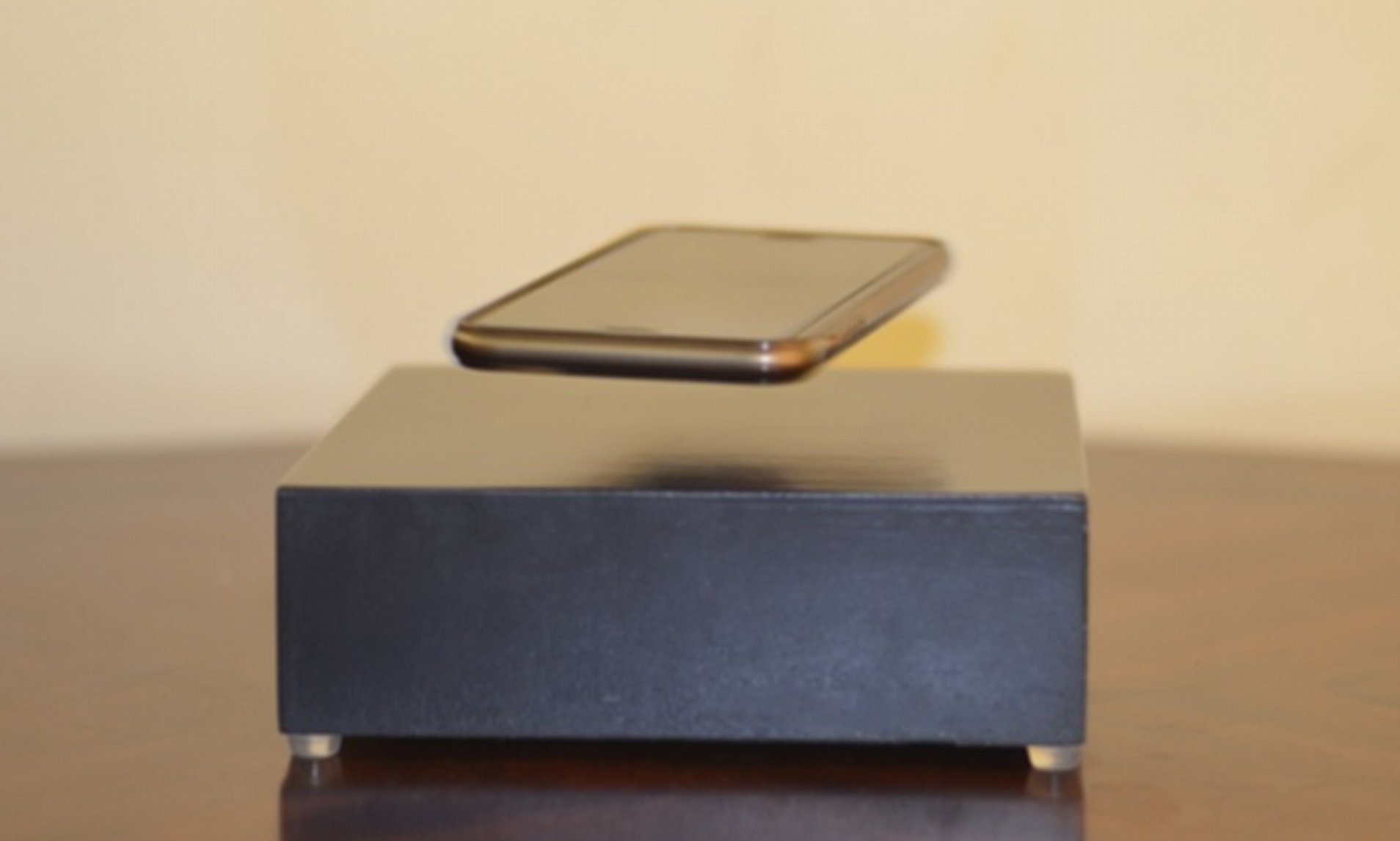
A levitating phone charger suspends your smartphone in mid-air using magnets while it wirelessly charges the battery, combining a futuristic visual effect with the convenience of cable-free power. This niche gadget uses magnetic levitation and electromagnetic induction to create the illusion of your phone floating, making it a conversation starter rather than a practical everyday charger for most users.
What is a levitating phone charger?
A levitating phone charger is a device that uses opposing magnetic fields to hold a smartphone in the air while simultaneously transferring power to it wirelessly. Unlike standard wireless chargers that require the phone to sit flat on a pad, this charger makes the device hover a few centimeters above its base. It remains a niche, futuristic gadget, more of a novelty than a mainstream accessory, because of its higher cost, specialized case requirements, and limited compatibility with current phone models.
The science behind magnetic levitation and wireless charging
The levitation effect comes from two sets of magnets: one in the charging base and one in a special case or receiver attached to the phone. These magnets are arranged so that their like poles face each other, creating a repelling force strong enough to lift the phone. The base contains a coil that generates an alternating magnetic field, which induces an electric current in a second coil inside the phone or its case, this is electromagnetic induction, the same principle used in all Qi wireless chargers. The careful alignment of the magnets and coils keeps the phone stable in mid-air while power flows from the base to the battery.
A look at real-world levitating chargers like the OvRcharge
The most documented levitating charger is the OvRcharge, which was introduced via Kickstarter and combines magnetic levitation with induction charging. It requires a separate special phone case that contains both an induction receiver and a magnet; the base houses the wireless charging and levitation hardware. The OvRcharge used a separate special phone case with an induction receiver and a magnet, and the base also contained the wireless charging and levitation hardware. According to product descriptions, the OvRcharge can support devices up to 600 grams, meaning it could work with many tablets in addition to smartphones. Another older product, the Air Charge, was advertised as working with any iPhone that had a Lightning port and "whichever case you use," but this claim comes from a 2016 Kickstarter-era page and does not reflect current support. The Air Charge was advertised as working with any iPhone with a Lightning port and 'whichever case you use,' but this is an older Kickstarter-era claim, not a current support page. No official manufacturer support pages currently exist for these levitating chargers, so exact setup steps, device lists, or charging limits are not available from verified sources.
What to consider before buying a novelty charger
Before purchasing a levitating charger, understand that no mainstream models are currently sold by major phone makers or accessory brands. The OvRcharge and Air Charge are older products from crowdfunding campaigns, and Apple’s current MagSafe charger, which uses magnets only for alignment, not levitation, is the closest modern alternative. Apple's current MagSafe charger page says the magnetic alignment experience applies to iPhone 12, iPhone 13, iPhone 14, iPhone 15, compatible iPhone 16 models, iPhone 17 models, iPhone Air, iPhone 18 Pro models, and iPhone Duo. Compatibility is a major limitation: you typically need a proprietary case with a built-in magnet and receiver, and the charger’s weight limit (around 600 grams) may exclude heavier phones or phones with thick cases. The difference between this and standard MagSafe magnetic alignment is critical: MagSafe uses magnets to snap the phone onto the charger, not to lift it, so a levitating charger is a fundamentally different product with its own compatibility and safety considerations.
When evaluating your phone wireless charging setup and compatibility, remember that a levitating charger will only work with phones that fit its special case and meet its weight limit. Regarding magnet strength and phone damage risk, the magnets in these chargers are designed to repel, not attract, the phone’s internal components, and the force is calibrated to avoid harm, though you should not place credit cards or medical implants near them. Finally, check whether it & is your phone qi-enabled; most modern phones support Qi wireless charging, but the levitating charger’s case may add a receiver if your phone lacks built-in Qi support.
Frequently Asked Questions
How does the levitation mechanism actually work?
The base contains a ring of permanent magnets and an electromagnet coil. When powered, the electromagnet creates a variable magnetic field that pushes against the magnet in the phone’s case, lifting it. Sensors in the base adjust the electromagnet’s current to keep the phone stable and centered.
Is it safe to leave my phone floating overnight?
Most levitating chargers include overcharge protection and temperature sensors, but because the phone is not physically connected, a power outage or accidental bump could cause it to drop. It is generally safer to use these chargers during the day when you can monitor them.
Can I use a levitating charger without a special case?
No. The levitation requires a magnet and induction receiver built into a dedicated case or adhesive module. Standard phones do not contain the necessary magnetic components to float, even if they support Qi wireless charging.
Will a levitating charger work with my iPhone or Samsung phone?
It will work only if the manufacturer offers a compatible case for your specific model. Older products like OvRcharge had cases for a limited range of phones, and no current levitating charger supports the latest iPhone or Galaxy models directly.
Does the charger work through a thick or metal case?
No. A thick case adds weight and distance, potentially exceeding the 600-gram limit or interfering with the magnetic field. Metal cases will block both the levitation and the wireless charging entirely.
For the wider topic, see phone wireless charging setup.
Related reading: What Is The Magnetic Ring On A Phone Case For.