




Where to Play Spades Right Now
You can play Spades immediately in your phone’s browser by visiting Spades.now. That site offers free partnership, solo, and Whiz games with bidding, nil, bags, a daily deal, leaderboards, and real-time multiplayer, all without downloading an app, creating an account, or granting notifications. It works on a touch screen, and the page loads in a standard mobile browser tab, so you keep your storage and your privacy.
How Spades Actually Works (If You’re Rusty)
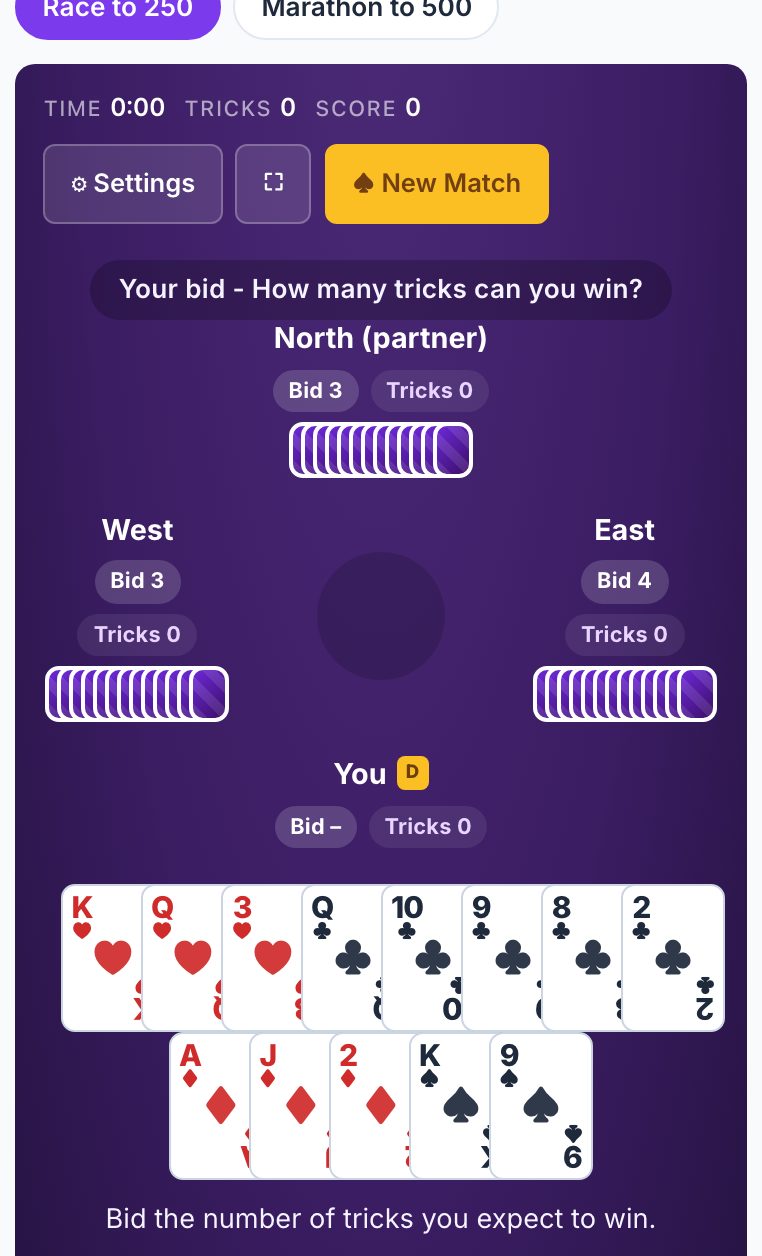
Spades is a trick-taking card game for four players in fixed partnerships. You get 13 cards. Before play begins, each player makes a bid, a number from 1 to 13, predicting how many tricks they will take that hand. The partnership’s bids add up to a combined target. The deck is standard 52-card, and spades are always trump. That means a spade beats any card of another suit, but you cannot lead spades until someone has “broken” them by playing a spade when they had no card of the led suit.
Play proceeds clockwise. The player to the dealer’s left leads any suit. Each other player must follow suit if they can. If you cannot follow, you may play any card, including a spade. The highest card of the led suit wins the trick unless a spade is played, in which case the highest spade wins. The winner of each trick leads the next one. The hand ends when all 13 tricks are played. Your partnership scores points based on how many tricks you took versus your combined bid.
The scoring is simple but strict. If you meet or exceed your combined bid, you get 10 points per trick bid, plus 1 point for each extra trick (called a “bag”). If you fall short, you lose 10 points per trick bid. Bags are dangerous: if you accumulate 10 bags over the course of the game, you lose 100 points. That rule forces you to bid accurately and avoid recklessly overtaking your contract.
The Decisions That Separate a Good Player from a Bad One
Beginners bid on raw card strength, high spades and aces. Good players think about distribution. A hand with a void suit (no cards of a suit) is worth more because you can trump in. A hand with many low cards in one suit is worth less because you will be forced to play them. You also have to read your partner’s bid. If your partner bids high, you should be aggressive in supporting them. If they bid low, you should play conservatively to avoid overtaking their tricks.
In play, the key decision is when to play high versus when to duck. If you are not trying to win the trick, play your lowest card of the led suit. If you are trying to win, play your highest card of that suit unless you have a strong reason to hold back. A good player tracks which cards have been played, especially the high spades. That lets you know when your remaining spade is a guaranteed winner.
Nil bidding is the biggest risk-reward decision. A nil bid means you predict you will take zero tricks that hand. If you succeed, you get a 100-point bonus. If you fail, you lose 100 points. You should only bid nil with a hand that has no obvious winners, no high spades, no aces, and ideally a long suit where you can dump losers. But even then, your partner must cover you by playing high cards to prevent you from being forced to win a trick. That is a partnership decision, not a solo one.
Bag management is the final layer. If you are close to 10 bags, you might deliberately throw a trick you could win to avoid the penalty. That is called “giving up the lead” or “ducking.” Conversely, if your opponents are close to 10 bags, you might try to force them to win a trick they do not want. That is why you sometimes see players lead a low card of a suit they know the opponent is void in, to make them trump in and take an unwanted trick.
What to Look for in a Place to Play on Your Phone
First, confirm the site works in a browser tab without a redirect to an app store. You want a page that loads quickly on a small screen and uses large touch targets for cards. You do not want to zoom or pinch to see the action. The cards should be tappable, and you should be able to drag or tap to play without accidental misclicks.
Second, check the game options. You want the ability to play with a partner (partnership), alone (solo), or with a different bidding style like Whiz (where your bid is exactly the number of spades you hold). The site you are using lists those modes, so you know they are available. You also want a daily deal or a leaderboard if you like a structured challenge, but those are extras, the core game should be playable without them.
Third, verify that you do not need an account. The whole point of browser play is to avoid sign-ups, storage, and notification permissions. A good browser game will let you join a table instantly, play a hand, and leave without any commitment. If a site asks for an email or a password, move on.
Finally, be realistic about screen size. A phone screen is fine for a single hand, but you will see fewer cards at once. On a small screen, you might not see the full trick history or the exact cards played earlier. That is fine for casual play, but if you are trying to track every card, a tablet or desktop will be easier. Do not expect the same overview you would get on a monitor, just play the hand you have in front of you.
Variants and Modes Worth Knowing
The most common variant is partnership Spades, where you and a partner combine bids. Solo Spades is for four players each playing for themselves, your bid is your own, and you score individually. Whiz is a stricter variant where your bid must equal the number of spades you hold. That removes a lot of strategic bidding and makes the game more about card play than prediction.
Nil is a bid you can add to any variant. It is a side bet that you will take zero tricks. Some games allow a “blind nil” (bidding nil without looking at your cards) for a bigger bonus, but that is risky and usually only in house rules. The site you are using lists nil as a feature, so you can expect it to be part of the standard rules.
Bags are a universal rule in most serious games. They prevent you from bidding low and then deliberately losing tricks to avoid penalties. If you are new, play a few hands with bags off to learn the flow, then turn them on for the real game. The daily deal and leaderboards are optional modes, they do not change the rules, just give you a target to play toward.
Frequently Asked Questions
Do I need to install anything to play on my phone?
No. The game runs entirely in your phone’s web browser. You do not download an app, and you do not give up storage space. You just open the link, and the game loads in a new tab.
Can I play with friends without an account?
Yes, but only if the site supports private tables. The site you are using does not mention private tables, so you should assume you are playing with strangers in real-time. If you want to play with specific friends, you would need a different service that offers that feature.
What happens if I close the browser in the middle of a game?
You will likely lose that game and take a loss on your record. Since there is no account, the game cannot save your progress. That is the trade-off for no sign-up. If you need to pause, look for a pause or leave button, but expect to forfeit the current hand.
Is it better to play on a tablet or desktop?
Yes, for serious play. A larger screen shows more cards and the full trick history, which helps you track what has been played. On a phone, you will see fewer cards and might miss subtle information. For a quick casual game, a phone is fine. For competitive play, use a bigger screen.
Can I play solo against the computer?
The site you are using lists “solo” as a mode, but that means four players each playing for themselves, not playing against a computer. If you want to practice against bots, you would need a different site that offers that specific feature. This one is for real-time multiplayer against other people.
More like this: Free Games You Can Play in Your Phone's Browser · Browser Games That Work on a Phone: The Directory