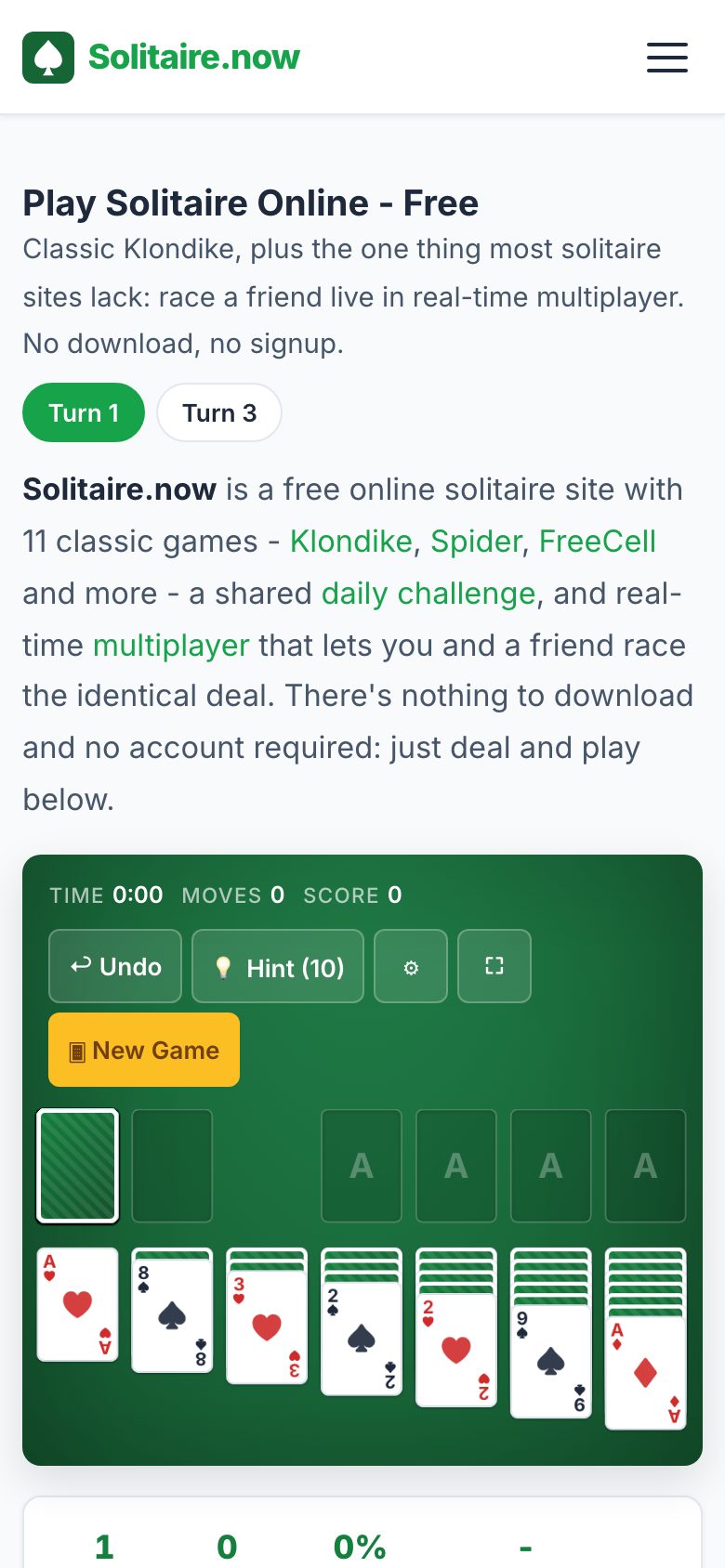





You can play Minesweeper.now right now in your phone’s browser at minesweeper.now, no app install, no account, and no storage space taken up. The page loads directly in your mobile browser, and you can start a game immediately. It’s the classic puzzle you remember, available wherever you have a signal.
How the Game Actually Works (Refresher for Rusty Players)
If you haven’t played in years, here’s the core: the board is a grid of hidden squares. Some squares contain mines; most don’t. Your goal is to reveal every square that does not contain a mine, without clicking on a mine itself.
When you tap a square, one of three things happens:
- You hit a mine, game over, instantly.
- You reveal a number, that number tells you how many mines are directly adjacent (including diagonally) to that square. Use that information to figure out which neighboring squares are safe.
- You reveal an empty area, if a square has zero adjacent mines, the game automatically reveals all touching squares, often opening up a large chunk of the board. This is what makes the early game fast.
On a phone, you tap to reveal. To mark a square you suspect is a mine, you long-press (or use the flag mode if the site provides one, but the core mechanic is the same). The numbers are your only clues. For example, a “1” means exactly one of the eight surrounding squares is a mine. A “3” means three of the surrounding squares are mines.
The game is turn-based, so there’s no time pressure unless you choose a timed mode. You can think, zoom in on the grid (if your browser supports pinch-zoom), and take your time. On a small screen, you may need to zoom in to see the numbers clearly, that’s normal and works fine in a mobile browser.
The Decisions That Separate a Good Player from a Bad One
Minesweeper looks like luck, but it’s a game of logic and probability. The difference between a beginner and a skilled player comes down to a few key habits:
- Start with a corner or an edge. Many players begin by clicking a corner square. Why? Because a corner has only three neighbors, so if it’s a number, it gives you less information than a center square, but it also has a higher chance of being a zero, which opens up a large area. On the other hand, some experts prefer starting in the middle to get more information early. The key is to have a deliberate first move, not a random tap.
- Use the “chord” or “double-tap” technique. On desktop, you can click both mouse buttons on a number that has all its adjacent mines flagged, this reveals all remaining neighbors. On mobile, this is often done by long-pressing or using a two-finger tap. If you’ve correctly flagged all the mines around a number, you can safely reveal the rest of the adjacent squares. This is the single biggest speed boost in the game.
- Don’t guess until you must. Early on, you often have forced guesses. But as the board fills in, you should rarely guess. If you have a “1” with one unrevealed neighbor, that neighbor is a mine. If you have a “2” with two unrevealed neighbors, both are mines. Learn the common patterns: “1-2-1” and “1-2-2-1” along edges often have deterministic solutions.
- Flag only when you’re sure. Some players flag everything they suspect, but flags are just markers, they don’t affect the game except to help you remember. Over-flagging wastes time. Only flag when you’re certain, or when you need to use the chord technique. On a phone, flagging takes extra taps, so use it sparingly unless you’re playing a no-guessing mode.
- Think in terms of “safe squares” first. Before you make a move, scan the board for any square that is 100% safe. If you find one, click it. If you find a square that is 100% a mine, flag it. Then re-evaluate. This iterative process clears most boards without a single guess.
On a phone, you’ll be slower than on a keyboard, but the logic is identical. The interface may require more deliberate taps, but that just means you should plan your moves more carefully.
What to Look for in a Place to Play (and Why This Works)
Not all browser-based games are equal. When you’re playing on a phone, you want a few specific things:
- No install, no sign-up. The whole point is to play instantly. If a site asks for an email or a download, it’s not what you want. A good browser game loads in under a few seconds and works immediately.
- Touch-friendly controls. The grid should respond to tap and long-press. The numbers should be legible on a small screen. If you have to zoom in and out constantly, it’s a poor experience. The best mobile browser games let you pinch-zoom, but they also have a layout that works at a reasonable zoom level.
- Reasonable data usage. A simple puzzle game shouldn’t eat your data. Minesweeper is lightweight, it’s just a grid of numbers. There’s no video or heavy graphics, so it works even on slow connections.
- No notifications or permissions. You shouldn’t have to grant access to your camera, microphone, or location. A pure browser game asks for nothing. If a site demands permissions, leave.
- Works offline? Some browser games can be cached, but not all. If you’re on a train or in a dead zone, you might want a game that works with no signal. But for most casual play, an internet connection is fine.
This particular site, minesweeper.now, fits the bill: it’s a web page, not an app. It doesn’t require an account, and it doesn’t send you push notifications. You just open the link and play. The page lists its features clearly, classic puzzle gameplay, multiple difficulty levels, and daily challenges, so you know what you’re getting before you start.
Variants and Modes Worth Knowing
If you’re new to the modern world of Minesweeper, you don’t have to stick to the basic grid. Here are a few modes you might encounter on a good site:
- Beginner, Intermediate, Expert. These are the classic three sizes. Beginner is usually 9x9 with 10 mines. Intermediate is 16x16 with 40 mines. Expert is 30x16 with 99 mines. On a phone, Expert is very hard to play comfortably because the squares are tiny, you’ll need to zoom in a lot. Stick to Beginner or Intermediate on a small screen unless you have a tablet.
- No-Guessing mode. This is a godsend for logic purists. In standard Minesweeper, there are often situations where you have to guess, and guessing can lead to a loss through no fault of your own. No-Guessing mode guarantees that every board is solvable using pure logic, no 50/50 coin flips. If you hate losing to luck, this is the mode for you.
- Daily challenges. Many sites offer a single puzzle per day, often with a specific goal (like clearing a certain number of mines or beating a time). This is a great way to get a quick fix without committing to a full game. It also adds a bit of variety, you’re not just replaying the same random boards.
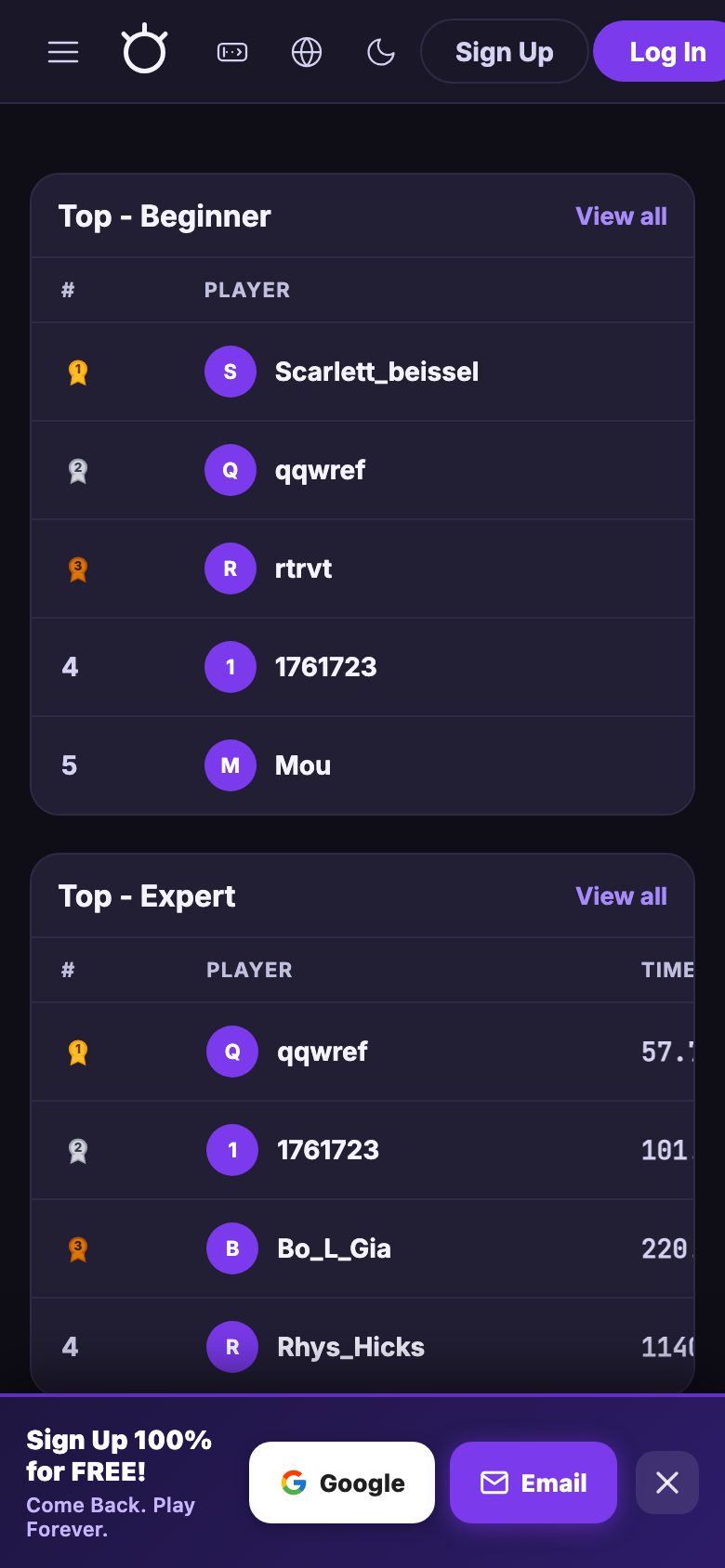
- Global leaderboards. If you’re competitive, you might want to compare your times with other players. But note: on a phone, you’re likely to be slower than a desktop player with a mouse. Don’t get discouraged, just aim to beat your own best time.
One thing to keep in mind: on a phone, the larger the board, the more you’ll have to pan around. A 30x16 expert board is technically playable, but it’s not fun if you’re constantly scrolling. For a better mobile experience, stick to Beginner or Intermediate, or use the “No-Guessing” mode on a smaller board to really test your logic.
Frequently Asked Questions
Do I need to create an account to save my progress?
No. This site doesn’t require an account, and it doesn’t track your progress across sessions. If you want to keep your stats or daily challenge streak, you might need to check if the site uses browser local storage, but you don’t need to sign up just to play a round. You can simply open the link and start playing instantly.
Can I play this on my phone without a mouse?
Yes, it’s designed for touch. You tap to reveal a square, and you long-press to flag a mine. The controls are a bit different from a mouse, but they’re intuitive. If you find yourself mis-tapping, try zooming in a bit more, the grid will become larger and easier to hit accurately.
What does “No-Guessing” mode actually do?
It ensures that every move you need to make is logically deducible from the numbers you have. In standard Minesweeper, there are positions where you have a 50/50 chance of hitting a mine. No-Guessing mode eliminates those situations, so you can win purely through reasoning. It’s a great way to learn the game without feeling cheated by random luck.
Is there a way to play with just one hand?
On a phone, you can hold the device with one hand and tap with your thumb, but for larger boards, you’ll likely need two hands. The game is turn-based, so you can take your time. If you’re on a small phone, you might find it easier to rotate the screen to landscape for a wider grid, or just stick to the smaller Beginner board.
What if I accidentally tap a mine and lose?
That’s part of the game, you lose that round. But you can start a new game immediately. There’s no penalty, no lives system, and no waiting. Just tap “New Game” or refresh the page. The key is to learn from your mistake: look at where you clicked and why it was a mine, and try to spot the pattern for next time.
More like this: Free Games You Can Play in Your Phone's Browser · Browser Games That Work on a Phone: The Directory