




You can play Blackjack right now in your phone’s browser at Blackjack.ooo, no app install, no account, and no storage space taken up. It loads directly in your browser, works with touch controls, and lets you start a hand in seconds. If you have a data connection or Wi‑Fi, you’re already at the table.
How the game actually works (for when you haven’t played in years)
Blackjack is you against the dealer, not against other players. The goal is to get a hand value closer to 21 than the dealer’s hand, without going over 21. Number cards are worth their face value, face cards (Jack, Queen, King) are worth 10, and an Ace is worth either 1 or 11, whichever helps your hand more.
You get two cards face up. The dealer gets two cards, one face up and one face down. Then you decide what to do with your hand. The dealer must follow a fixed rule: they hit until they have 17 or higher, then stand. That rule is the same every hand, so your decisions are the only variable.
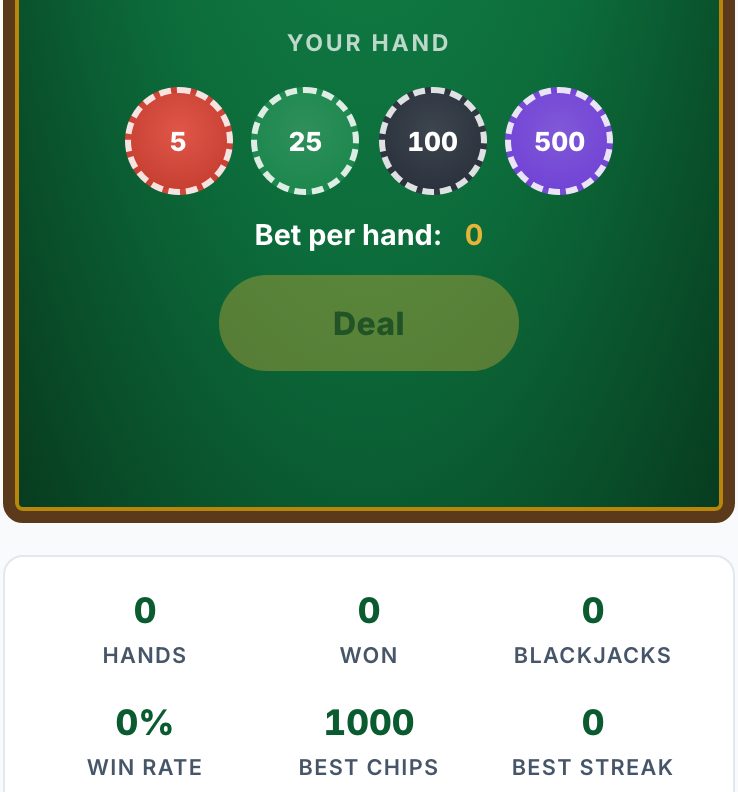
On a phone screen, you tap the buttons that appear on the table, usually “Hit,” “Stand,” “Double,” “Split,” and “Surrender” if the game offers it. The cards are big enough to read, and the buttons are sized for thumbs. You don’t need a mouse or a keyboard. Just tap.
If your first two cards are a pair (like two 8s), you can split them into two separate hands. If you have a strong total like 10 or 11, you can double down, that means you double your stake for one extra card. Surrender, when offered, lets you fold your hand immediately and lose only half your stake. Not every game offers surrender, but the one at the link above does.
One thing to remember: the dealer’s face‑down card is a mystery until the end. So you make your decisions based on what you can see, your hand and the dealer’s one up card. That’s the whole game.
The decisions that separate a good player from a bad one
Most people who “know” blackjack just hit until they get to 17 or higher. That’s not strategy, that’s guessing. The difference between a good player and a bad one is knowing what to do with your hand based on the dealer’s up card.
Here are the core decisions that matter:
- Hard totals (no Ace counted as 11): If you have 12 to 16 and the dealer shows 2 through 6, stand. The dealer is likely to bust. If the dealer shows 7 or higher, hit, you need to improve because the dealer probably has a strong hand.
- Soft totals (Ace counted as 11): If you have Ace‑6 (soft 17) or Ace‑7 (soft 18), you have flexibility. Double down on Ace‑6 or Ace‑7 if the dealer shows 3 through 6. Otherwise, hit or stand depending on the total.
- Doubling down: Only double when you have 10 or 11 and the dealer shows a lower card (2 through 9). Doubling on a 10 against a dealer’s 6 is a classic strong move. Doubling on a 12 or higher is usually wrong.
- Splitting: Always split Aces and 8s. Never split 10s or 5s. Split 2s, 3s, and 7s only if the dealer shows a weak up card (2 through 7).
- Surrender: If you have 16 and the dealer shows a 10, surrender if the game allows it. That’s a losing hand either way, but surrendering loses less over time.
These aren’t guesses, they come from probability tables that have been worked out for decades. The good news is you don’t have to memorize them perfectly to improve. Just remember the basics: stand on 12‑16 against a dealer’s 2‑6, hit against 7 or higher, and double on 10 or 11 when the dealer is weak.
The biggest mistake new players make is hitting when they should stand, just because they’re scared of the dealer’s face‑up card. But the dealer’s up card is the only information you have, and it tells you a lot. A dealer showing a 4, 5, or 6 is in a bad spot, they will bust more often than not. Let them.
What to look for in a place to play it
Not every blackjack game is the same. If you’re playing in a browser, you want a few things that make the game fair and playable on a phone:
- No download, no sign‑up: The whole point of browser play is that you tap a link and you’re in. If a site makes you create an account or install an app, it’s not what you’re looking for.
- Clear controls: On a small screen, the buttons need to be big enough to tap without mis‑tapping. If you can’t read the cards or the buttons, move on.
- Proper payouts: A standard blackjack pays 3 to 2 when you get a natural blackjack (Ace + 10). Some games pay 6 to 5, which is worse for the player. Look for 3 to 2.
- Rule options: Does the game offer surrender? Double after split? These rules change the odds slightly. More options usually mean more control, which is good for a practiced player.
- Practice mode: You want a game that lets you play without any pressure. A free, no‑account game is perfect for practicing your decisions until they’re automatic.
The site linked above has all of these. It’s a free classic blackjack game with 3 to 2 payouts, hit/stand/double/split/surrender, and no sign‑up. It also has 16 other blackjack variants, a daily challenge, and live multiplayer, but you don’t need any of that to start. You just need the basic game.
Variants and modes worth knowing
Once you’re comfortable with classic blackjack, you can try other versions. The site at the link above has 17 total blackjack games, but you don’t need to play them all. A few worth knowing:
- Classic Blackjack: The standard game. This is what you should learn first.
- Daily Challenge: A fresh hand‑to‑hand puzzle or goal that resets every day. It’s a good way to test your decision‑making under a time limit.
- Live Multiplayer: You play against other people’s decisions (not against them directly). It’s a different feel, you can see how others play, which is sometimes helpful and sometimes just funny.
- Other variants: Some games change the rules slightly, like paying 6 to 5 instead of 3 to 2, or allowing you to double on any two cards. Read the rules before you start.
For a phone browser, stick with classic first. The buttons are simpler, and you don’t need to read a lot of text to understand what’s happening. Once you’ve got the hang of it, branch out.
Frequently Asked Questions
Do I need to create an account to play?
No. The game at the link above loads directly in your browser with no sign‑up. You tap the link, the cards appear, and you play. That’s it.
Will this game work on my phone’s small screen?
Yes, it’s designed for touch. The cards and buttons are sized for a phone screen. That said, if you’re playing a variant with a lot of side bets or a complex table layout, it might feel cramped. Stick to classic blackjack on a phone, it’s the most comfortable.
Is this the same as playing in a real casino?
It’s the same rules and the same decisions, but there’s nothing at stake. You’re playing with points, not anything of value. That makes it a great place to practice your strategy without pressure.
What’s the best strategy for a beginner?
Memorize the basic rule: stand on 12-16 when the dealer shows 2-6, hit when the dealer shows 7 or higher, and always split Aces and 8s. Double on 10 or 11 when the dealer is weak. That covers most hands you’ll see.
Can I play this on a tablet or only a phone?
It works on both. A tablet gives you a bigger view, which is nicer for seeing all the cards at once. A phone works fine, but you might need to scroll slightly on some screens. The game itself is responsive, so it adapts to your screen size.
More like this: Free Games You Can Play in Your Phone's Browser · Browser Games That Work on a Phone: The Directory