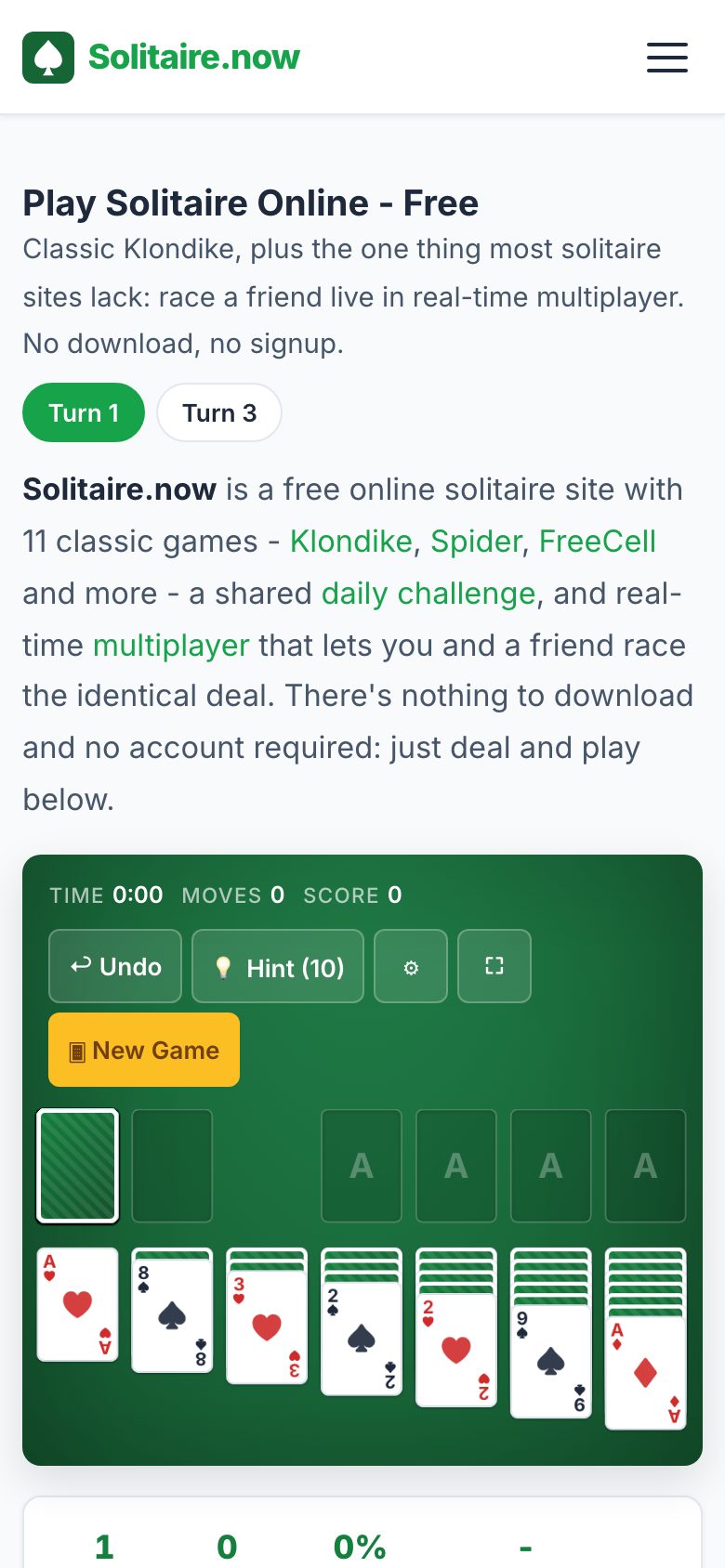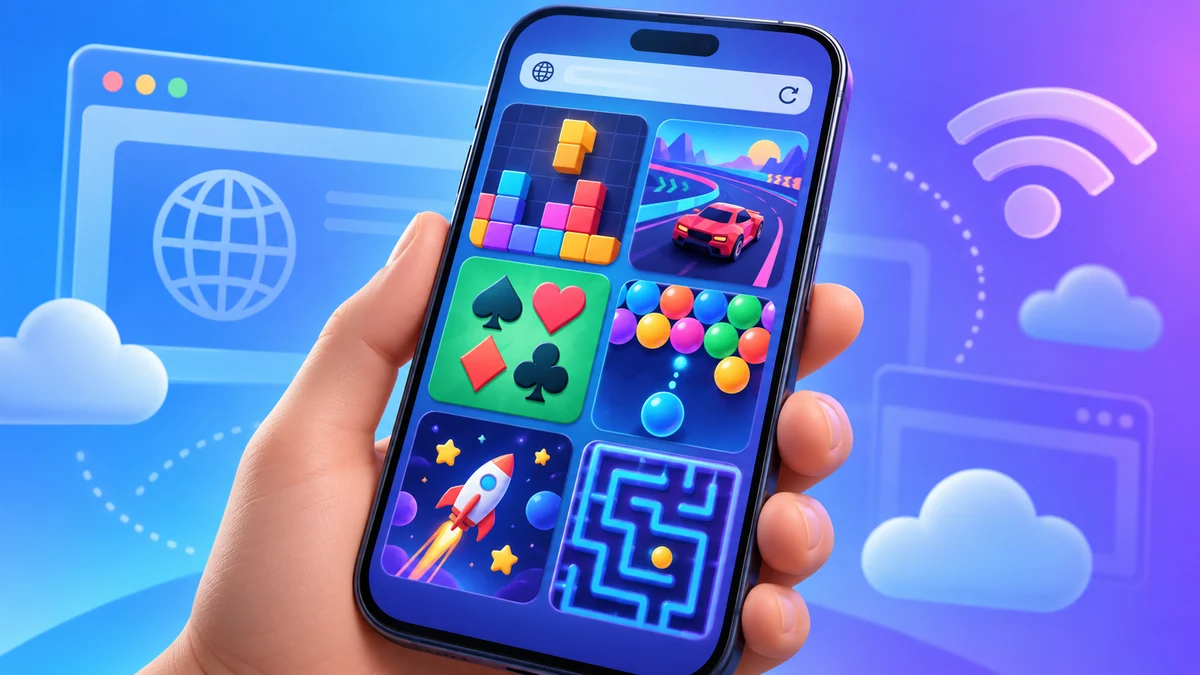





You can play FreeCell right now in your phone’s browser by heading to Freecell.now, no app install, no storage taken, no account needed. It works on the small screen with touch controls, and you can start a game in the time it takes to tap a link. If you are reading this on a phone, that is the place to play.
How FreeCell actually works (if you have not played in years)
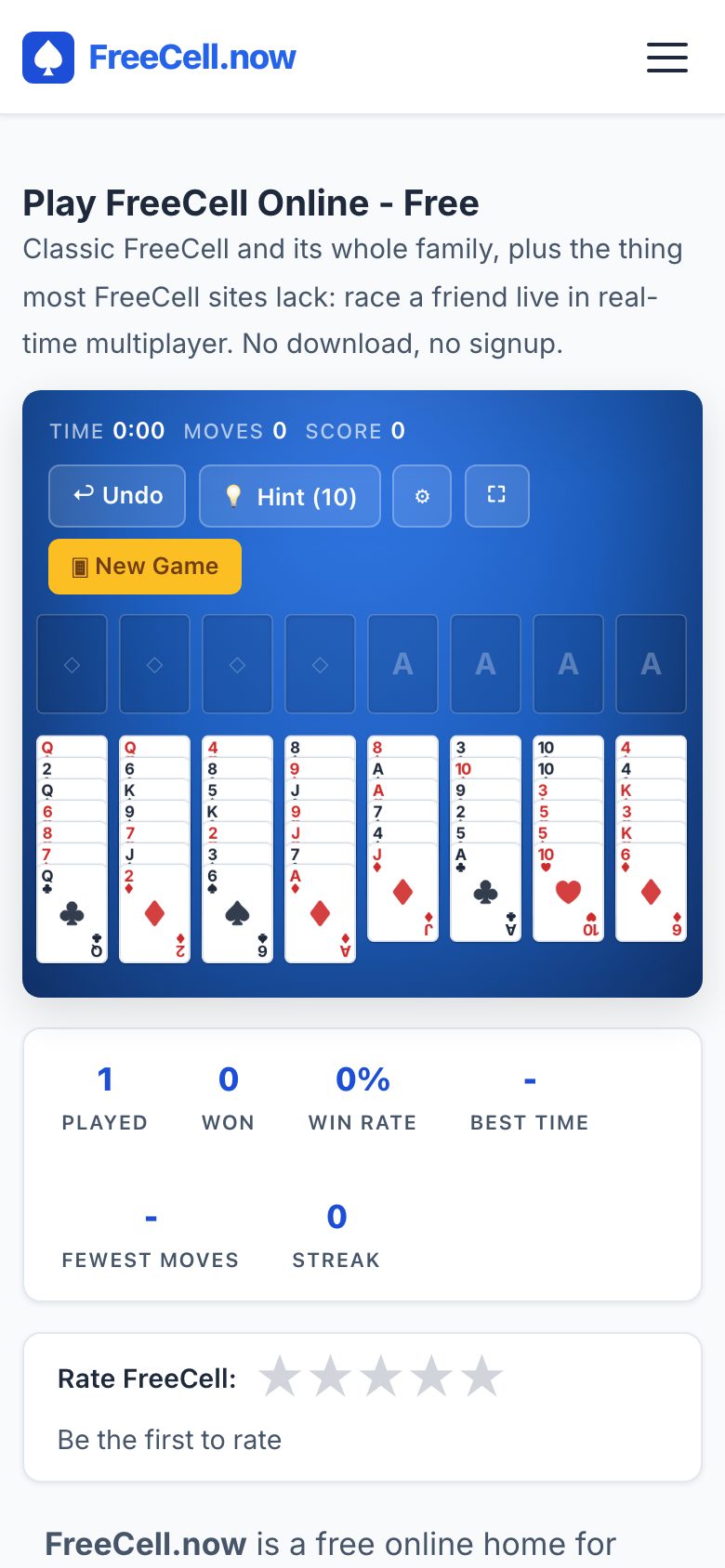
The whole table is dealt face up, every card is visible from the start. That is the core difference from other solitaire games: there is no luck in what you cannot see, only in the choices you make. You have four free cells at the top left, which act as temporary parking spots for single cards. The goal is to build four foundation piles at the top right, one per suit, from Ace to King.
You move cards around the tableau columns, stacking them in descending order and alternating colours. A black 7 can sit on a red 8, a red 9 on a black 10, and so on. You can move a sequence of cards only if you have enough free cells and empty columns to hold the intermediate cards, that is the puzzle. An empty column can take any single card or a properly built sequence, which makes it the most valuable space on the board.
On a phone, the touch controls are simple: tap a card to select it, then tap where you want it to go. If you make a mistake, there is an unlimited undo button, so you can experiment without penalty. The interface is built for a small screen, cards are large enough to read, and you do not need to zoom or scroll sideways to see the whole table.
One thing to know: because every card is face up, a lost game is almost always a planning error, not bad luck. You can see the entire layout before you make your first move, so take a few seconds to scan for Aces and twos, they are your first targets.
The decisions that separate a good player from a bad one
FreeCell is a game of foresight, not speed. A bad player moves cards one at a time and fills up their free cells early. A good player treats those four free cells as precious real estate, each one used is a temporary loss of flexibility. Before you park a card in a free cell, ask yourself: “What else could I do with this spot in the next two moves?”
The second big decision is when to empty a column. An empty column is the only place you can park a long sequence, and it effectively gives you extra storage. Good players work towards an empty column early, even if it means moving cards in a roundabout way. Bad players avoid the effort and run out of space later.
Third, look for the “home stretch”, when you have a run of cards in the same suit, even if they are not perfectly ordered, you can often move them up to the foundations in one go. For example, if you have a red 10, 9, and 8 in a column, and the black 7 is free, you can move the whole run up once the Aces and twos are placed. Recognising these hidden runs is what turns a stuck position into a win.
Finally, do not be afraid to undo. The game has unlimited undo for a reason, it is not cheating, it is part of the strategy. If a move leads nowhere, undo it and try a different path. On a phone, this is especially useful because you might mis-tap a card; undo fixes that instantly.
What to look for in a place to play FreeCell
Not every browser game is worth your time. The first thing to check is whether the game loads without forcing a download or a sign-up, the one at Freecell.now does not, which is why it works for a quick game on the bus or in a waiting room. It should also work offline in the sense that the page loads fast and does not hammer your data plan with ads or trackers.
Second, look for the basics: unlimited undo, hints when you are stuck, and a way to restart a game without reloading the page. On a phone, you also want the cards to be big enough to tap accurately, if you find yourself mis-tapping, the game is not designed for mobile, and you should move on.
Third, check for daily challenges. A good FreeCell site offers a new puzzle each day, which gives you a reason to come back. The site at freecell.now has daily challenges, and they are a great way to learn the game, each one is a fresh puzzle with a known solution, so you can compare your play against a “perfect” run.
Finally, consider whether the game offers live multiplayer. That is a different beast, it is not about patience but about racing another player to solve the same layout. It is a fun twist, but it is not for everyone. If you just want a quiet game, stick to single-player mode. If you want a challenge, try the multiplayer option, but be warned, it is more stressful than relaxing.
Variants and modes worth knowing
The most common variant is the standard 52-card game, which is what you get by default. But there are a few modes worth trying once you get comfortable. The first is the daily challenge, a single hand that everyone plays, with a leaderboard if you care about comparing scores. It is a good way to test your skill against a known solution.
Second, some versions offer “one-suit” or “two-suit” games, which are easier because you only have to manage one or two suits instead of four. These are perfect for learning the mechanics without the full mental load. On the other hand, “four-suit” is the standard challenge, that is the real FreeCell.
Third, look for a “hint” system that does not just tell you the next move but explains why. The site at freecell.now has hints, and they are useful when you are stuck, they show you a move you might have missed, which is often the difference between a win and a loss. Do not be ashamed to use them; even experienced players need a nudge sometimes.
Finally, there is the question of “winnable” hands. In FreeCell, nearly every deal is winnable, but not all are. If you get a hand that seems impossible, it might be one of the rare unwinnable ones, just deal a new game. Do not waste an hour on a lost cause when you can start fresh in seconds.
Frequently Asked Questions
Do I need to create an account to play?
No. The game at freecell.now runs entirely in your browser, there is no sign-up, no email, and no password. You just open the page and play. Your progress is saved automatically in your browser’s storage, so you can close the tab and come back later without losing your place.
Will this game take up space on my phone?
No. Because it is a web page, not an app, it does not install anything. It uses a small amount of temporary memory while the page is open, but it does not store files on your device. When you close the tab, everything is cleared. This is the main advantage over an app, you get the game without the storage cost.
Can I play with one hand on a phone?
Yes, for the most part. The game is designed for touch, and you can tap cards with your thumb. However, if you are playing a complex hand with lots of moves, you might find it easier to use two hands or rotate your phone to landscape mode. It works either way, but a bigger screen helps, if you have a tablet or a computer nearby, that is a better choice for long sessions.
What happens if I make a mistake?
Use the undo button, it is unlimited, so you can take back as many moves as you like. There is no penalty for undoing, and it is often the best way to learn. If you are truly stuck, use the hint button to see a suggested move. The game is about solving the puzzle, not about being perfect the first time.
Is FreeCell the same as other solitaire games?
No. The key difference is that all cards are face up, so there is no hidden information. This makes it a game of skill rather than luck, you can plan your entire game from the start. Other solitaire games like Klondike (the classic Windows version) have hidden cards, which adds an element of chance. If you prefer pure strategy, FreeCell is the better choice.
More like this: Free Games You Can Play in Your Phone's Browser · Browser Games That Work on a Phone: The Directory