



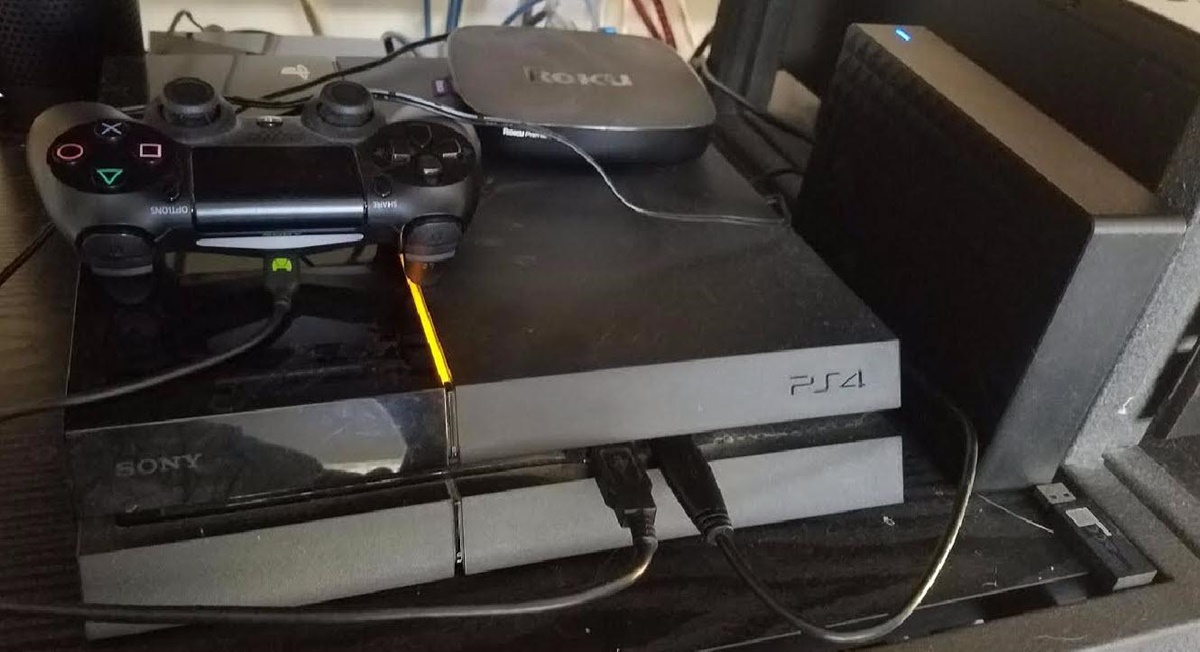
To get your PS4 to read an external hard drive docking station, the dock must present the drive as a standard USB mass-storage device that the console can recognize as extended storage. This works when your PS4 runs system software 4.50 or later and the drive inside the dock meets Sony’s capacity and speed requirements, letting you install and play more games without touching your internal drive.
What you need before you connect a PS4 read external hard drive docking station
Before you set up a PS4 read external hard drive docking station, confirm your console and drive meet the documented limits. Your PS4 must run system software version 4.50 or later, because external storage support arrived in that update. The drive itself must be a SuperSpeed USB 5Gbps-or-later external HDD, with a minimum capacity of 250 GB and a maximum of 8 TB. The dock must act as a direct USB connection to the console; Sony documents support for a USB external hard disk drive connected directly to the PS4, not through a hub, and does not separately document docking-station-specific compatibility. If your dock presents the drive as a standard USB mass-storage device, the PS4 should see it the same way it sees any other external drive, but that setup is not officially documented by Sony.
You also need to make sure the drive is an external hard disk drive, not just any USB device like a thumb drive or phone. The connection must be SuperSpeed USB 5Gbps or later, so older USB 2.0 docks may not work. Capacity matters too: anything below 250 GB or above 8 TB will not be accepted as extended storage. If you are using a multi-bay dock, only the drive you intend to use for games should be connected when you format and transfer, because the PS4 will treat the entire dock as one USB storage device.
Format the drive as extended storage on your PS4
Formatting the drive on the PS4 itself is the only reliable way to prepare it for extended storage. The console will erase the drive and set it up with the file system it needs, so back up anything important before you start.
- Connect the drive in the dock to your PS4 using a USB cable.
- On your PS4, go to Settings > Devices > USB Storage Devices.
- Select the drive you want to use.
- Choose Format as Extended Storage.
The PS4 supports only exFAT and FAT32 file systems for external storage devices; if the drive is not already formatted to one of these, it must be reformatted before use. Reformatting will erase all data on the drive, so back up important files before proceeding. Older PS4 models may only support the FAT32 file system, which has a maximum file size limit of 4GB. The PS4 will format the drive and assign it as extended storage automatically. After formatting, the drive will appear under your console’s storage settings. There is no separate file-system menu on the PS4 for this process, and no iPhone or Android app path is involved; formatting happens entirely on the console.
Connect the docking station and make the PS4 recognize it
Once the drive is formatted, you can connect the dock and confirm the PS4 sees it. The order of operations matters for a clean handshake between the dock, the drive, and the console.
- Power off your PS4 completely.
- Plug the dock into a USB port on the PS4 using the dock’s USB cable.
- Power on the dock, then power on your PS4.
- Go to Settings > Storage and confirm the external drive appears alongside System Storage.
If the drive does not appear immediately, wait a few seconds. The PS4 may take a moment to recognize a drive in a dock, especially if the dock has its own power switch. Make sure the dock is powered on before the console finishes booting. The drive should show up as extended storage, ready for game installation and transfers.
Move games to the external drive
With the drive recognized, you can move applications from your PS4’s internal storage to the external drive. This frees up space on the system drive while keeping your games installed and playable.
- Go to Settings > Storage > System Storage > Applications.
- Press the Options button on your controller.
- Select Move to Extended Storage.
- Choose the games or applications you want to move, then confirm.
The transfer speed depends on the drive and the USB connection, but SuperSpeed USB 5Gbps will handle most moves quickly. Once moved, you can launch those games directly from the external drive. Note that Sony documents moving applications, not save data or screenshots, as part of the external-drive setup; save data stays on the internal storage unless you manage it separately.
What to do when the PS4 still does not see the drive
If the PS4 does not recognize the drive in the dock, work through these checks in order. The most common issue is that the dock is not acting as a direct USB connection, or the drive itself does not meet the documented requirements.
- Check USB direct connection: Sony documents a direct USB connection to the console, not through a hub. If your dock is connected through a USB hub, remove the hub and plug the dock directly into a PS4 USB port.
- Avoid hubs: Even a powered hub can interfere with the PS4’s ability to see the drive. The dock should be the only intermediary between the drive and the console.
- Verify capacity and speed: The drive must be 250 GB minimum and 8 TB maximum, and it must be SuperSpeed USB 5Gbps or later. A USB 2.0 drive or a drive outside that capacity range will not work.
- Re-format on the PS4 if needed: If the drive was formatted on a computer or previously used with another device, the PS4 may not see it until you format it again. Go to Settings > Devices > USB Storage Devices, select the drive, and choose Format as Extended Storage.
If the drive still does not appear, try a different USB port on the PS4, or test the drive in a different dock. The PS4 only supports a USB external hard disk drive connected directly to the console, so if the dock introduces any non-standard behavior, the console may reject it.
Frequently Asked Questions
Can I use any external hard drive docking station with my PS4?
Only if the dock presents the drive as a standard USB mass-storage device and the drive itself meets Sony’s requirements: SuperSpeed USB 5Gbps or later, 250 GB to 8 TB capacity, and system software 4.50 or later. Sony does not separately document docking-station-specific support, so compatibility depends on the dock acting like a direct USB connection.
Can I use any external hard drive with my PS4?
Yes, as long as it is USB 3.0 compatible with a minimum capacity of 250GB and a maximum of 8TB.
Do I need a docking station for an external hard drive to work with my PS4?
No. A docking station is not required; you can connect a standard USB external hard drive directly to the PS4. A dock is only useful if you want to swap drives easily or use a bare internal drive that lacks its own enclosure.
What are the benefits of using a docking station for an external hard drive with my PS4?
It provides a secure and stable connection, and often comes with additional ports like USB hubs, card readers, and charging capabilities.
Will the PS4 format my drive and erase everything on it?
Yes. When you choose Format as Extended Storage, the PS4 erases all data on the drive. Back up any files you want to keep before formatting.
Can I use the docking station with other devices besides my PS4?
Yes, most docks work with PCs, laptops, and other consoles, and some even include extra ports like card readers or USB hubs. However, once a drive is formatted as PS4 extended storage, other devices may not read it until you reformat it.
What happens if I connect the dock through a USB hub?
The PS4 may not recognize the drive. Sony documents a direct USB connection to the console, and hubs can cause the drive to be missed. Plug the dock directly into a PS4 USB port instead.
For the wider topic, see laptop docking stations.
Related reading: How To Set Up Headset On PS4.